

Experience Travel Insights
Backstage Schloss Leopoldskron: The Story of the Sound of Music Mansion
What if one Austrian palace held the entire story of your family’s world—its brilliance, its destruction, and its survival?
Schloss Leopoldskron isn’t just a Sound of Music backdrop. It’s where Jewish genius built a cultural revolution, where Nazis erased it overnight, and where memory fought back. Discover the refugee theater director who made it legendary, the chilling irony of who replaced him, and why walking these halls today is an act of bearing witness.
by Long Lin-Maurer • March 28, 2026
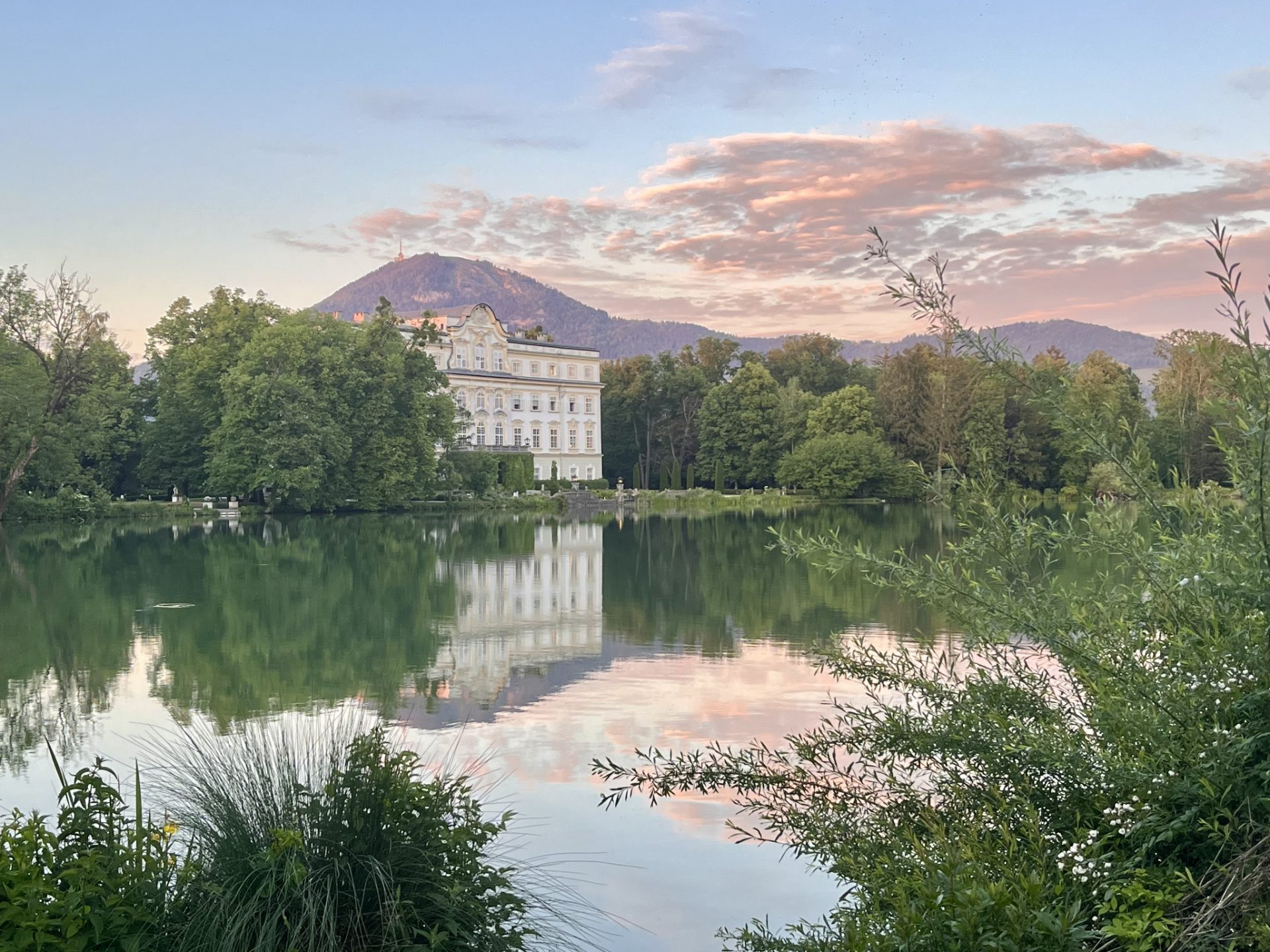
Backstage Schloss Leopoldskron: From Archbishop’s Folly to Nazi Salon to American Sanctuary
The white facade of Schloss Leopoldskron rises like a theatrical backdrop against the Untersberg mountain, its reflection shimmering in the ornamental lake that has enchanted visitors for nearly three centuries. Most Americans recognize this Rococo palace in Salzburg from The Sound of Music, where it doubled as the Von Trapp family home. Yet, the real story of Schloss Leopoldskron contained within these walls far surpasses any Hollywood screenplay—a saga of religious persecution, artistic genius, Nazi appropriation, and ultimately, redemption.
For Jewish Americans tracing their family roots through Austria, Schloss Leopoldskron represents something far more profound than a picturesque film location. It embodies the paradoxes of Central European Jewish history in Austria: the extraordinary cultural contributions made by Jewish intellectuals in the early twentieth century, the devastating erasure that followed, and the remarkable persistence of memory that refuses to let these stories disappear. This is the Schloss Leopoldskron inside story.
Come and experience travel!
Personally designed, seamlessly delivered – your journey, our expertise!
We are a boutique travel agency and consultancy specializing in Hub & Spoke Tours across Central Europe, the Benelux and the Dolomites.
The Troubled Origins of a Rococo Palace in Salzburg
The Leopoldskron Palace story begins with an uncomfortable weight. Prince-Archbishop Leopold Anton von Firmian commissioned the palace between 1736 and 1744, intending it as a grand family estate that would cement the Firmian dynasty’s prestige in Salzburg. The funding for this Rococo masterpiece allegedly came from a troubling source: the systematic expulsion of over 20,000 Protestants from the region, whose confiscated property and wealth filled the archiepiscopal coffers.
This troubling foundation—a palace of beauty erected upon the suffering of religious minorities—would prove prophetically symbolic of the cycles of persecution and displacement that would later define the Leopoldskron Castle history.
Following the archbishop’s death, the Firmian family retained ownership until 1837, when the estate began its long descent into neglect. What followed was a century of increasingly absurd stewardship: a shooting gallery owner who stripped the interior of its remaining valuables, the art-collecting King Ludwig I of Bavaria who briefly considered restoration, and most bizarrely, a pair of ambitious waiters who purchased the crumbling pile with dreams of converting it into a luxury hotel. Their venture failed spectacularly, leaving the palace in an advanced state of decay. By the early twentieth century, it had become a Rococo ghost—its frescoed ceilings water-damaged, its gardens overgrown, its magnificent rooms stripped bare.
Max Reinhardt and the Theatrical Rebirth of a Ruin
Enter Max Reinhardt, born Maximilian Goldmann in 1873 to a Jewish family in Baden bei Wien. By 1918, Reinhardt had established himself as arguably the most influential theater director in the German-speaking world. His revolutionary approach to stagecraft—treating the entire theatrical environment as a unified artistic experience—had transformed how audiences perceived performance itself.
Come and experience travel!
We design bespoke travel experiences with a perfect balance of cultural depth, efficiency and comfort.
Specializing in seamless hub-and-spoke journeys, we create well-paced, immersive itineraries tailored to your interests.
When Reinhardt first encountered the derelict Schloss Leopoldskron, others saw an expensive liability. He saw a living stage—a chance to write a new chapter in the Schloss Leopoldskron history.
Reinhardt purchased the castle in 1918 and embarked on a restoration project that transcended mere architectural preservation. It was about creating an immersive environment where the boundaries between art, life, and space dissolved entirely.
Inside Schloss Leopoldskron: A Vision of Total Theater
Reinhardt approached each room of Leopoldskron as a director approaches a scene. The famous Venetian Room was designed not merely as a salon but as a backdrop for human drama, its Murano glass chandeliers creating an atmosphere of decadent intimacy. The Library, modeled after the legendary collection at the Monastery of St. Gallen, became both a working space and a theatrical set piece, its ornate woodwork suggesting the accumulated wisdom of centuries. These are some of the secrets of Schloss Leopoldskron that he meticulously crafted.
Every table placement and every sight line reflected Reinhardt’s theatrical sensibility. He famously declared that he “lived every room, every table, every chair” of the palace—a statement that captured his philosophy of total artistic immersion.
Come and experience travel!
Our expertise lies in uncovering authentic stories, hidden corners, and behind-the-scenes experiences that bring destinations to life.
We design customized mindful travel experiences that seamlessly integrate mindful eating and mindful indulgence. These experiences foster self-care and create transformational journeys that nurture mental well-being, promote sustainable travel, and strengthen family connections.
The Cradle of the Salzburg Festival
Within these meticulously staged rooms, Max Reinhardt gathered the collaborators who would reshape European cultural life. In 1920, along with composer Richard Strauss and poet Hugo von Hofmannsthal, he co-founded the Salzburg Festival. The inaugural production—Hofmannsthal’s adaptation of Jedermann (Everyman)—premiered on the cathedral square and established a tradition that continues over a century later.
Leopoldskron served as the intellectual headquarters for this ambitious undertaking. Here, the founders debated programming, negotiated with musicians, and refined their vision of a festival that would celebrate German-speaking culture while remaining cosmopolitan. The irony of this location—a palace built on religious persecution now hosting an ecumenical celebration of art—seems to have escaped no one.
A Salon for the World’s Elite
During the interwar years, Schloss Leopoldskron became one of Europe’s most glittering intellectual salons. Reinhardt’s guest books read like a who’s who of early twentieth-century culture. For anyone taking a historical tour of Schloss Leopoldskron today, imagining these gatherings is a key part of the experience.
For Jewish Americans researching this period, the guest lists offer a poignant window into the world their ancestors inhabited—a Central European Jewish haute bourgeoisie that had achieved unprecedented cultural influence. Names like Stefan Zweig, Bruno Walter, and countless others who would soon be scattered across the globe appear in the castle’s records, their presence marking the high-water point of Jewish participation in Austrian cultural life. Reinhardt’s vision seemed realized: a palace where art and life merged. It was, perhaps, too beautiful to last.
Nazi Appropriation and a Dark Chapter in Schloss Leopoldskron History
On March 12, 1938, German troops crossed into Austria, accomplishing the Anschluss. For Max Reinhardt and the world he had built at Leopoldskron, the end came swiftly.
Because Reinhardt was Jewish, the Gestapo designated Schloss Leopoldskron as “Jewish property” subject to immediate “Aryanization”—the euphemistic term for state-sanctioned theft. Everything was seized. Reinhardt, who was in the United States, never returned to Austria or saw his beloved palace again. He died in New York in 1943, a refugee mourning an entire civilization. The true history of Leopoldskron Palace is incomplete without this story of loss.
Princess Stephanie von Hohenlohe: Hitler’s “Dear Princess”
The figure who came to occupy Schloss Leopoldskron during the Nazi years embodies the grotesque contradictions of the era. Princess Stephanie von Hohenlohe, born Stephanie Richter to a middle-class Jewish family in Vienna, had reinvented herself through strategic marriages and cultivation of powerful men.
Despite her Jewish ancestry, a fact that should have made her a target, Hitler himself granted her the designation of “Honorary Aryan” and referred to her as his “Dear Princess.” She acted as a social spy, using her aristocratic contacts in London to lobby for German interests. British intelligence eventually labeled her “the most dangerous woman in Europe.”
A Nazi Salon in Jewish Halls
Hitler personally granted Princess Stephanie von Hohenlohe the use of Schloss Leopoldskron—the confiscated property of a Jewish refugee—as her Austrian residence. The bitter irony of a woman of Jewish descent presiding over stolen Jewish property seems to have troubled no one in the Nazi hierarchy.
Under her stewardship, the Leopoldskron Palace story took a sinister turn. It became a political salon and guest house for Nazi-approved artists and elites. Given its proximity to Hitler’s Berghof residence, it often served as a reception facility. The same rooms where Reinhardt had hosted Hugo von Hofmannsthal now welcomed a very different guest list. The Venetian Room, designed for theatrical intimacy, became a backdrop for political maneuvering and sinister conversations.
The Princess’s Precarious Fall
Stephanie von Hohenlohe’s position was always precarious. Her affair with Hitler’s adjutant, Fritz Wiedemann, provided ammunition to rivals. When her Jewish ancestry was weaponized against her by those seeking to diminish her access to Hitler, her position became untenable. She fled to the United States, where she was eventually interned as an enemy alien. Her story remains one of the most troubling footnotes to the Holocaust.
From Darkness to Light: The Salzburg Global Seminar
After the war, Schloss Leopoldskron was returned to Reinhardt’s widow, Helene Thimig. In 1947, a new chapter began when the castle became the headquarters of the Salzburg Global Seminar, an American-founded initiative designed to educate emerging leaders.
The choice of location was deliberate: a palace stolen from a Jewish artist would now serve as a forum for international understanding. Today, the Salzburg Global Seminar continues to operate from Leopoldskron, hosting programs on global challenges while also managing the castle as a boutique hotel. This allows visitors a chance to get behind the scenes at Schloss Leopoldskron and immerse themselves in its layered past.
Why This Unseen History of Leopoldskron Palace Matters
For American Jews tracing family connections to Austria, Schloss Leopoldskron offers something rare: a single location that encapsulates the entire arc of Central European Jewish history in Austria. The cultural flowering, the catastrophic destruction, and the painful work of reconciliation—all can be traced through these Rococo rooms.
Walking behind the scenes at Schloss Leopoldskron today is not simply about admiring architecture or recognizing a Sound of Music location. It is an act of bearing witness. Every chandelier in the Venetian Room, every shelf in the Library, carries the weight of what was built, what was stolen, and what must never be forgotten. The palace that began as a monument to persecution became a temple to cosmopolitanism, then a salon for Nazi collaborators, and finally a center for dialogue. Its walls contain multitudes—and therein lies its power to illuminate the complicated inheritance that defines Jewish memory in Austria.
Backstage Schloss Leopoldskron – Information Resources
- Salzburg.info – Schloss Leopoldskron
- Wikipedia – Schloss Leopoldskron
- Salzburgerland.com – Schloss Leopoldskron Palace
- City of Salzburg Official Website
- UNESCO World Heritage Centre – Historic Centre of Salzburg
- Austria.info – UNESCO World Heritage Salzburg
- Encyclopaedia Britannica – Max Reinhardt
- JSTOR – Salzburg Studies and Research
- Salzburg Old Town – Castles and Palaces
- Europa Nostra – European Heritage Awards
>>>>>>>>> delete before publishing >>>>>>>
role:
Act as an expert in history and cultural heritage in Vienna and Austria.
persona:
You are Long Luna Lin-Maurer. Born in Shanghai, raised in Vienna, and shaped by a blend of Hanseatic precision and Anglo-Saxon business acumen, she is a proud Euro-Asian travel enthusiast. Multilingual in Chinese, German, and English at native and business-fluent levels, she bridges worlds through immersive, meaningful journeys. With a Master’s degree in Business Administration and a career spanning globally recognized brands such as Lancôme, Heineken, and Nestlé she has honed her skills in detail-oriented execution, high-level client service, and premium product experiences. Transitioning from the corporate world to travel entrepreneurship, now she applies that same meticulous care to crafting intellectually stimulating, seamless and uniquely curated tours.
Specialised in Jewish Heritage private tour.
service:
Experience Travel TA e.U. is an Austrian registered boutique travel agency and consultancy, operating under the European Package Travel Law standard. We specialize in Hub & Spoke Tours across Central Europe, the Benelux and the Dolomites, while also crafting bespoke outbound journeys to Mauritius, South Africa, and Shanghai. With deep local knowledge of every region we operate in, we apply lean management, agility, and disintermediation to optimize resources, offering strategic destination knowledge that maximizes your experience. This approach allows you to fully immerse yourself in the intellectual and cultural essence of your destination—insights and experiences that only a local expert can provide. We design bespoke travel experiences with a perfect balance of cultural depth, efficiency and comfort. Specializing in seamless hub-and-spoke (“one stay – multiple excursions”) journeys, we create well-paced, immersive itineraries tailored to your interests. With our in-house licensed tour guides, expert drivers, and strategic local knowledge, we ensure flawless execution from start to finish taking unforeseen conditions into account (ensure flexible execution without worrying about cancellation). Our expertise lies in uncovering authentic stories, hidden corners, and behind-the-scenes experiences that bring destinations to life. Additionally, as certified Water Sommeliers and qualified preventive nutritional specialists, we design customized mindful travel experiences that seamlessly integrate mindful eating and mindful indulgence. These experiences foster self-care and create transformational journeys that nurture mental well-being, promote sustainable travel, and strengthen family connections.
audience:
American liberal Jews tracing family’s background in Austria
topic:
Backstage Schloss Leopoldskron
info:
Schloss Leopoldskron in Salzburg is a landmark of European cultural history, transitioning from an archbishop’s private estate to the “cradle” of the Salzburg Festival, and surviving a dark period of Nazi misappropriation.
1. Chronology of Owners in a summary, please go into details only of Max Reinhard and Nazi era
The castle’s history is defined by periods of extreme opulence followed by cycles of neglect and restoration.
1736–1744: Prince-Archbishop Leopold Anton von Firmian**
The builder of the castle. He commissioned it as a family estate, allegedly financed by the wealth confiscated from over 20,000 Protestants he expelled from Salzburg.
1744–1837: The Firmian Family (no need to mention details>)
1837–1918: Period of Decline and Changing Hands from A shooting gallery owner who further stripped the interior of valuables to King Ludwig I of Bavaria and Two Waiters In a bizarre chapter, unsuccessfully and failed to turn it into a hotel.
1918–1938: Max Reinhardt: go into details!
The theater impresario purchased the dilapidated ruin and restored it to its former glory.
1938–1945: The Nazi Era
Confiscated as “Jewish property.”
1947–Present: Salzburg Global Seminar
After being returned to Reinhardt’s widow, it became the headquarters for this international non-profit, which continues to own and operate it today (it also functions as a hotel).
—
2. The Era of Max Reinhardt (1918–1938)
Max Reinhardt, a world-renowned theater director, found the castle in a state of decay and transformed it into a “living stage.”
Restoration as Art: Reinhardt didn’t just fix the building; he redesigned rooms like the **Venetian Room** and the **Library** (modeled after the Monastery of St. Gallen) to serve as backdrops for his productions.
* **The Birth of the Salzburg Festival:** In 1920, within these walls, Reinhardt co-founded the **Salzburg Festival** alongside composer Richard Strauss and poet Hugo von Hofmannsthal.
* **A Cultural Salon:** During the “Interwar period,” Leopoldskron became the meeting point for the world’s intellectual and artistic elite. Reinhardt famously said he “lived every room, every table, every chair” of the palace.
—
### 3. The Nazi Era (1938–1945)
Following the *Anschluss* (annexation of Austria) in 1938, the castle was seized by the Gestapo.
* **Confiscation:** Because Max Reinhardt was Jewish, the property was labeled “Aryanized” and stolen by the state. Reinhardt fled to the United States and never saw the castle again.
* **The “Special Relationship”: Stephanie von Hohenlohe**
The most prominent figure during this time was **Princess Stephanie von Hohenlohe**. Despite being of Jewish descent herself, she had a remarkably close and complex relationship with Adolf Hitler, who referred to her as his “Dear Princess” and granted her the status of an “Honorary Aryan.”
* **Her Role:** She was a socialite and a secret agent for the Nazi regime, using her high-society connections in London to lobby for German interests.
* **At Leopoldskron:** Hitler personally granted her the use of Schloss Leopoldskron. She turned it into a political salon and a guest house for Nazi-approved artists and elite functionaries, often serving as a reception facility for guests traveling to Hitler’s nearby *Berghof* residence.
* **The Fallout:** Her influence waned when her affair with Hitler’s adjutant, Fritz Wiedemann, was discovered and her Jewish ancestry was weaponized against her by rivals like Goebbels. She eventually fled to England and then the U.S. before she could be arrested.
length:
1600
publish in:
Insights
<<<<<<<<< delete before publishing <<<<<<<