

Experience Travel Insights
Mozart’s Last Hour: The Midnight Requiem Vigil Inside St. Stephen’s Cathedral
Imagine experiencing Mozart’s Requiem at the exact moment of his death.
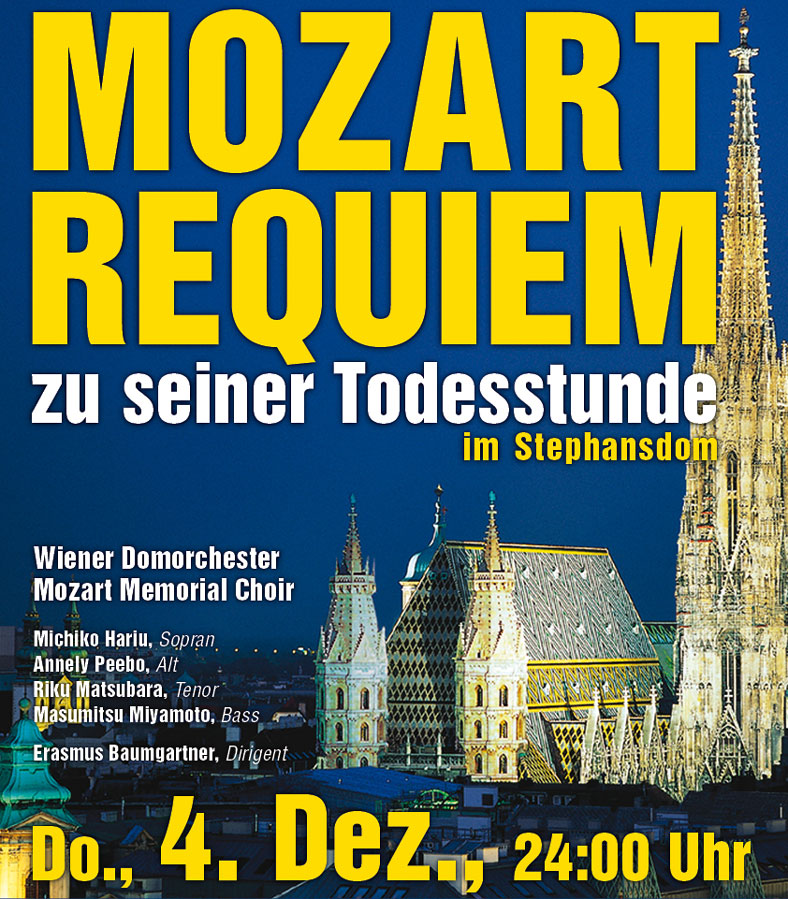
This article unveils Vienna’s unique midnight vigil, where St. Stephen’s Cathedral hosts a performance culminating at 0:55 a.m., reliving the composer’s final breath.
Discover the deep historical ties and spiritual immersion that transform this unfinished masterpiece into a profound connection to Mozart’s genius and mortality.
by Long Lin-Maurer • December 4, 2025
Mozart’s Last Hour: The Midnight Requiem Inside St. Stephen’s Cathedral
Vienna, a city where cobblestones echo with the ghosts of genius, holds one of classical music history’s most poignant chronicles. Each year, as the 4th of December bleeds into the 5th, a unique and deeply moving part of the Viennese musical tradition unfolds within the hallowed walls of St. Stephen’s Cathedral (Stephansdom). It is a pilgrimage for the soul, a communion with a spirit that departed all too soon. As the clock strikes midnight, an orchestra and choir assemble to perform Wolfgang Amadeus Mozart’s Requiem, his final, unfinished masterpiece. This is no ordinary concert; it is a meticulously timed vigil, a sonic reenactment of a composer’s race against mortality, culminating at the precise moment of his death: 0:55 a.m. To be present for this late-night Requiem concert is to witness an auditory reliving of Mozart’s final moments—a convergence of time, place, and sound that continues to fascinate and haunt aficionados more than two centuries later.
Come and experience travel!
Personally designed, seamlessly delivered – your journey, our expertise!
We are a boutique travel agency and consultancy specializing in Hub & Spoke Tours across Central Europe, the Benelux and the Dolomites.
The Story of Mozart’s Death: A Countdown to Eternity
At 12:55 a.m. on December 5, 1791, Wolfgang Amadeus Mozart, aged only 35, succumbed to a severe illness. His final days were consumed by a feverish effort to complete his Requiem Mass in D minor, a commission shrouded in mystery. The work, ordered by an anonymous patron (later revealed to be Count Franz von Walsegg, who intended to pass it off as his own), became Mozart’s personal confrontation with the divine. Accounts from his wife, Constanze Mozart, suggest he became convinced he was writing the mass for his own funeral. “I feel definitely,” he is reported to have said, “that I will not last much longer; I am sure I have been poisoned.”
While the popular Antonio Salieri myth has been largely debunked, the sentiment reveals a mind grappling with its own finitude. The annual performance is a ritualistic commemoration that aligns the final notes of the “Lux aeterna” with the composer’s last breath, creating an unbroken thread between his life, his death, and his eternal legacy.
Legend tells of Mozart on his composer’s deathbed, the score of his final work brought to him. Hours before his passing, he gathered friends to sing through the completed parts. They reached the first bars of the “Lacrimosa,” a movement of profound sorrow, when Mozart, overwhelmed, broke down in tears. The Requiem is immortal not only for its beauty but for its incompletion—a testament to a genius extinguished mid-phrase. Mozart had only fully orchestrated the opening sections himself. The remainder was a musical puzzle that fell to his student, Franz Xaver Süssmayr, to solve. Guided by Mozart’s sketches, Süssmayr’s completion is the version most known today, a faithful conclusion to the composer’s last composition.
Stephansdom: A Cathedral Woven into Mozart’s Life and Death
The choice of Vienna’s historic cathedral for this annual rite is no coincidence; this Gothic masterpiece is woven into the fabric of Mozart’s life. It was within these sacred walls that he married Constanze Weber in 1782 and where two of his children were baptized. The cathedral represented not just a place of worship but a pillar of his domestic and professional life.
Come and experience travel!
We design bespoke travel experiences with a perfect balance of cultural depth, efficiency and comfort.
Specializing in seamless hub-and-spoke journeys, we create well-paced, immersive itineraries tailored to your interests.
Months before his death, Mozart applied for the prestigious position of adjunct music director at the cathedral, a role that would have secured his family’s future. Tragically, he would not live to see the appointment fulfilled. The cathedral, a site of his greatest joys and aspirations, would ultimately become the first stop on his final journey. On December 6, 1791, a modest funeral service was held for Mozart within St. Stephen’s. From there, his body was taken to the St. Marx cemetery for a simple burial. The cathedral stands as the indisputable point of origin for his passage into history. This annual performance in St. Stephen’s is therefore a profound act of homecoming. The thunderous chords of the “Dies Irae” reverberate with the weight of judgment, while the pleading strains of the “Lacrimosa” ascend toward the heavens, transforming the performance into a deeply spiritual and overwhelming sensory event.
The Nocturnal Requiem Performance: An Unbroken Chord in Time
For the audience, the experience transcends a typical concert. It is an immersive Mozart’s death vigil and a meditation on mortality. The atmosphere inside the cathedral as midnight approaches is thick with anticipation. The dim lighting casts long, dancing shadows across ancient stone pillars. A reverent hush falls over the crowd, a collective breath held in anticipation of the opening notes of the “Introitus.”
As the clock hands creep toward that final, fatal minute, we are not just listening to music; we are witnessing a sacred ritual. This nocturnal Requiem performance is not merely a tribute but an act of temporal connection, a deliberate collapsing of the centuries that separate the listener from the composer. It is a shared experience of counting down the last moments of a life that gifted the world so much beauty.
When the final bell tolls at 0:55 a.m., marking the exact moment Mozart’s life ended, the Requiem concludes. The final “Amen” hangs in the air, a whisper of peace. In that singular, timeless moment, the composer, his unfinished masterpiece, and the city he called home are united. The music fades, but the emotional resonance endures, a powerful reminder of the fragility of life and the immortal power of art. For those who seek to understand Vienna, this midnight requiem offers an unparalleled glimpse into the city’s very essence—a place where genius and tragedy are forever intertwined, and where sacred choral music provides the ultimate solace.
Come and experience travel!
Our expertise lies in uncovering authentic stories, hidden corners, and behind-the-scenes experiences that bring destinations to life.
We design customized mindful travel experiences that seamlessly integrate mindful eating and mindful indulgence. These experiences foster self-care and create transformational journeys that nurture mental well-being, promote sustainable travel, and strengthen family connections.
Mozart’s Last Hour: The Midnight Requiem in St. Stephen’s Cathedral
- St. Stephen’s Cathedral Official Website – Provides official information on events, including the annual performance of Mozart’s Requiem on the anniversary of his death.
- Mozarthaus Vienna – The official museum in the house where Mozart lived offers deep insights into his life in Vienna, his compositions, and his final years.
- City of Vienna’s Historical Wiki (in German) – Offers a historical overview of Mozart’s time in Vienna, including his connection to St. Stephen’s Cathedral and his death.
- Britannica Encyclopedia on the Requiem – A scholarly article detailing the history, composition, and mythology surrounding Mozart’s Requiem.
- BBC Music Magazine on Mozart’s Requiem – Provides an accessible yet informative overview of the work, its history, and recommended recordings.
- Digital Mozart Edition by the Mozarteum Foundation – A scientific and freely accessible online database of Mozart’s compositions, including the score and fragments of the Requiem.
- Austrian Academy of Sciences – Mozart’s Correspondence – A scholarly resource providing access to Mozart’s letters, which offer personal insights into his life and work during his final year.
- Library of Congress – Autograph Manuscript of Mozart’s Requiem – Digital images of the original manuscript of the Requiem, allowing for a direct look at Mozart’s handwriting and compositional process.
- The New York Times Archive: Mozart’s 200th Anniversary – An archival article reflecting on the commemoration of Mozart’s death in Vienna, providing historical context to the modern-day performances.
- Wiener Zeitung Article on Mozart’s Last Days (in German) – A detailed article from a reputable Austrian newspaper discussing the historical facts and myths surrounding Mozart’s death and funeral.