

Experience Travel Blog
Decoding the Masterpieces of Power: KHM Through the Lens of a Cultural Mentor
What if a museum visit could feel like peer-reviewing a 3,000-year chain of engineering breakthroughs? Vienna’s Kunsthistorisches Museum encodes millennia of material science, biomechanical innovation, and political propaganda into its very architecture and collections. This guide reframes ancient artifacts as case studies—from the structural paradigm shift of contrapposto to onyx carved at the strata boundary with astonishing precision. For analytical minds, it’s not a tour. It’s a structured investigation.
by Long Lin-Maurer • October 3, 2026
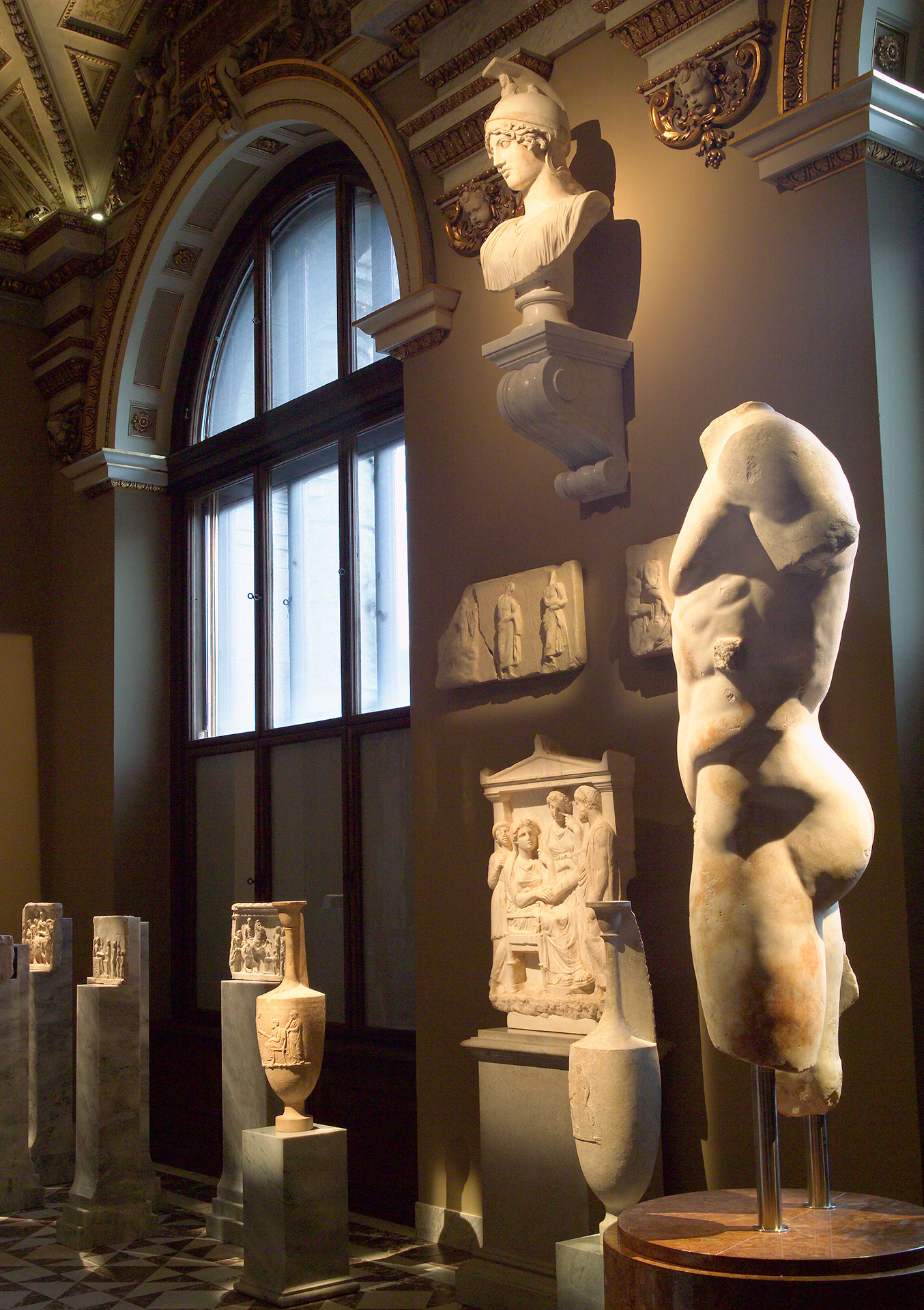
KHM Through the Lens of a Cultural Mentor: Private Guidance Notes for the Kunsthistorisches Museum
To step inside the Kunsthistorisches Museum in Vienna is not simply to visit a gallery of antiquities. It is to enter a meticulously engineered argument about civilization itself—one built in stone, bronze, marble, and semi-precious mineral. Every room, every structural element, every curatorial decision encodes a thesis about how political power, artistic innovation, and imperial ambition shaped the aesthetic grammar of the Western world.
For the analytically inclined visitor—someone accustomed to examining systems, questioning mechanisms, and tracing causation—KHM Vienna offers an extraordinary case study. The collections do not merely display beautiful objects. They document a chain of technological and conceptual breakthroughs spanning three millennia, from the rigid certainties of Pharaonic sculpture to the fluid propaganda of the Roman state. These guidance notes are designed to sharpen that reading, transforming a museum visit into a structured intellectual encounter with the material evidence of civilizational evolution.
The Architecture as Primary Artifact: Habsburg Imperial Legacy Written in Egyptian Stone
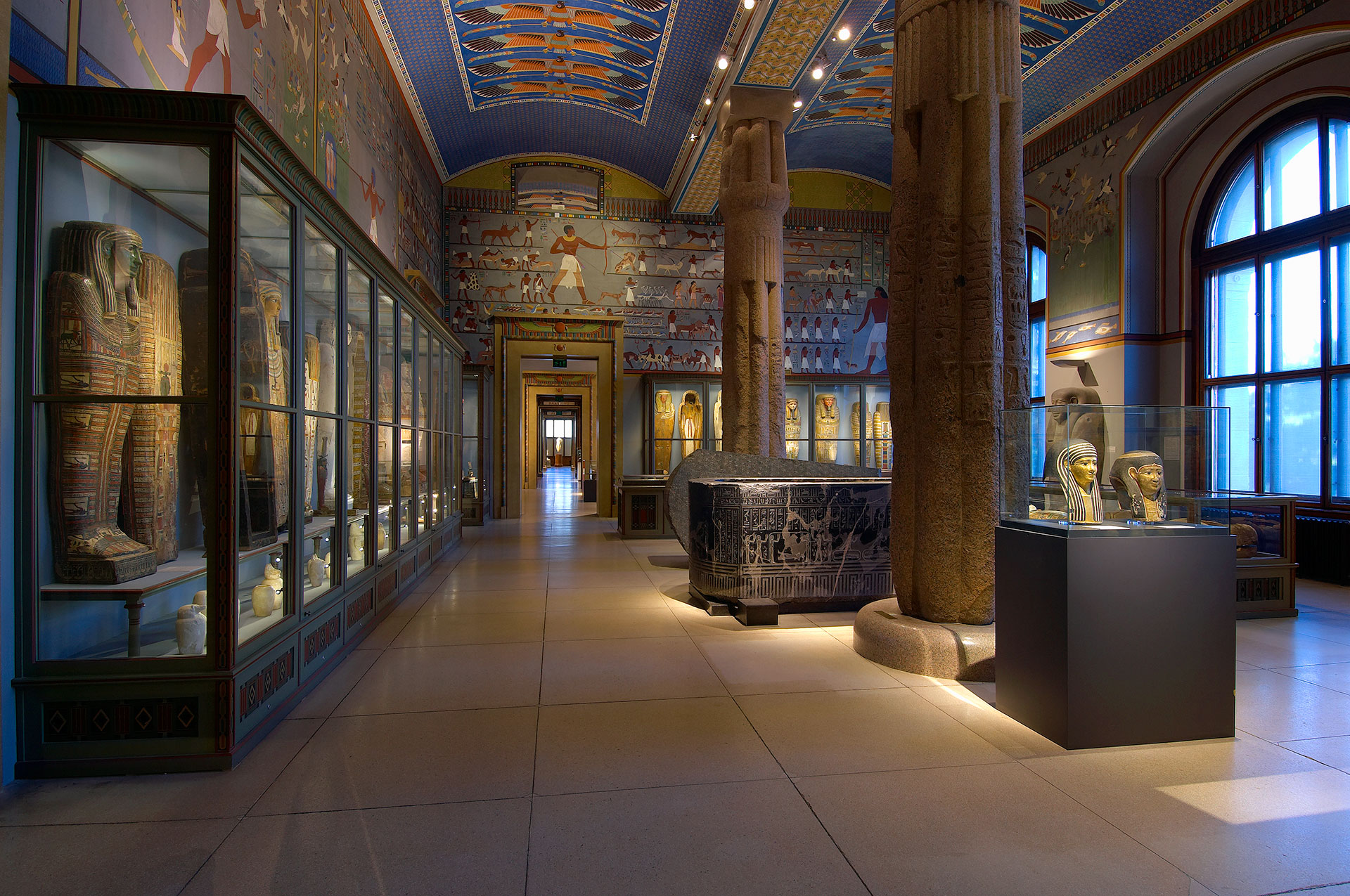
Most visitors begin by looking at the objects in the vitrines. The more rewarding approach is to look first at the room itself.
Come and experience travel!
Personally designed, seamlessly delivered – your journey, our expertise!
We are a boutique travel agency and consultancy specializing in Hub & Spoke Tours across Central Europe, the Benelux and the Dolomites.
The Egyptian Collection at KHM is housed beneath massive papyrus-bundle columns—monolithic elements gifted to Emperor Franz Joseph I during the historic opening of the Suez Canal in 1869. These are not decorative replicas. They are authentic Egyptian monoliths, transported from the Nile Valley to the Ringstrasse, and installed as load-bearing structural pillars of the Habsburg museum.
The engineering decision is worth pausing over. The Habsburgs did not relegate these columns to a courtyard or a decorative alcove. They made them foundational—literally supporting the ceiling above the Egyptian galleries. The architectural message is precise: Habsburg imperial grandeur is not merely inspired by the ancient Pharaohs; it is structurally anchored in their monumental tradition. The Suez Canal monoliths function simultaneously as construction material and as ideological statement, embedding the dynasty’s self-narrative into the very bones of the building.
This fusion of imperial visual ideology and structural engineering sets the interpretive tone for the entire museum. At KHM, architecture is never neutral. Every room is a designed experience, and recognizing this from the first threshold changes how every subsequent object is perceived.
From Egypt to the Aegean: The Cyprus Votive Statue and the Mechanics of Artistic Transition
The Egyptian galleries at KHM offer something that a trip to Luxor or Giza cannot: Egypt placed in direct, curated conversation with Greco-Roman antiquity. The collection is arranged to make visible the transfer of artistic technique across the ancient Mediterranean—a transmission that rewired the visual language of an entire civilization.
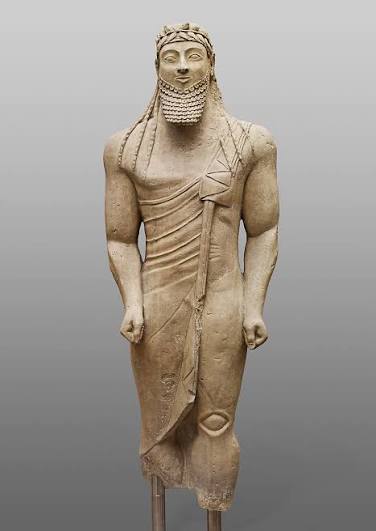
One of the most instructive objects in this sequence is the Cyprus Votive Statue (Votivstatue eines Mannes), dating to approximately 550–525 BC. Cyprus, geographically and culturally positioned at the intersection of Egypt, the Near East, and the emerging Archaic Greek world, produced artifacts that function almost like transitional fossils in a biological record.
Examine this figure closely. The posture retains the rigid frontality characteristic of Egyptian sculptural convention—feet planted, arms fixed, gaze locked forward. Yet something is shifting. There are early signals of naturalistic observation creeping into the anatomy: a softening of the torso, a suggestion of organic proportion that Egyptian canon did not pursue. The statue stands at a hinge point, bridging Egyptian formal mastery and the emerging Greek impulse to describe the human body as it actually moves and bears weight.
This is not merely an aesthetic shift. It represents a fundamental change in what sculpture was understood to do—from encoding divine permanence to investigating biological reality.
The Biomechanics of Contrapposto: A Paradigm Shift Carved in Stone
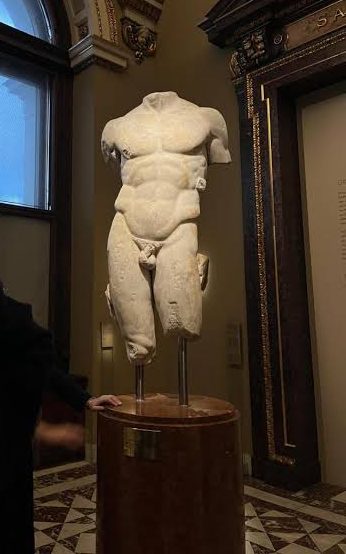
The breakthrough that the Cyprus Votive Statue foreshadows reaches its full expression in the adjacent galleries, where Greek and Roman figures demonstrate the principle known as contrapposto—or, in the German art-historical terminology used throughout the museum, Supporting (or engaged) Leg and Free (or relaxed) Leg.
This is worth understanding as a structural innovation rather than a purely aesthetic one. For millennia, Egyptian and Near Eastern sculptors distributed weight symmetrically across both legs, producing figures of extraordinary stability and authority but zero kinetic implication. The Greek discovery—likely emerging in the early fifth century BC—was that shifting the body’s mass onto one leg while relaxing the other triggers a cascading chain of anatomical adjustments: the pelvis tilts, the spine curves in compensation, the shoulders counter-rotate, and the entire figure assumes a subtle S-curve that mirrors the biomechanics of actual human standing posture.
The result is a figure that appears to exist in time—capable of having just moved or being about to move. This single structural discovery in ancient figurative art revolutionized the representation of the human body and has remained the foundational posture of classical balance in sculpture, painting, and even contemporary fashion photography and product design. Observing the KHM’s busts and full-figure sculptures in sequence, tracking the gradual mastery of weight distribution from static to dynamic, is to watch one of the most consequential engineering insights in the history of visual culture unfold room by room.
The Labyrinth Mosaic: Mythology Translated Through Mathematical Precision
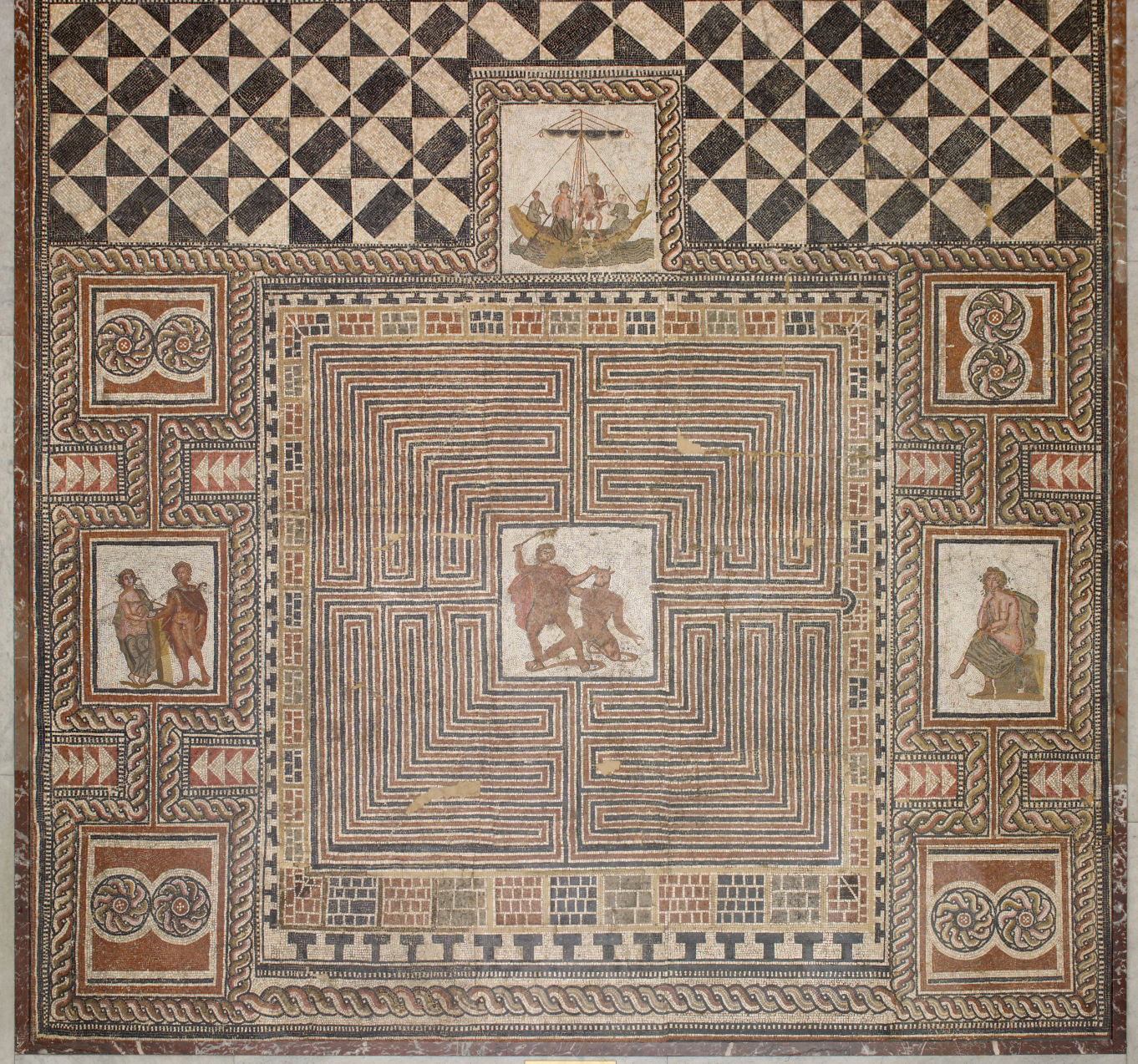
Transitioning into the Greek and Roman antiquities, the gaze should shift downward. Set into the floor is the Theseus Labyrinth Mosaic, depicting Theseus confronting the Minotaur within the legendary Cretan maze.
The narrative content is familiar. What rewards closer inspection is the method. The labyrinth is rendered as a rigorous geometric construction—concentric pathways governed by strict symmetry and mathematical translation of a mythological concept into spatial pattern. The mosaic artist did not illustrate a story so much as diagram one, using tesserae (small cut stone or glass tiles) arranged with a precision that speaks to the same systematic rigor found in Roman engineering and urban planning.
This artifact demonstrates how ancient Mediterranean cultures used decorative art as an information-encoding system. The labyrinth is simultaneously ornament, narrative, and geometric proof—a visual argument that myth and mathematics are not opposing languages but complementary ones. For visitors trained in data visualization or systems modeling, the mosaic is a strikingly modern artifact in its logic.
The Isis-Aphrodite Sculpture and the Ancient Mastery of Wet Drapery
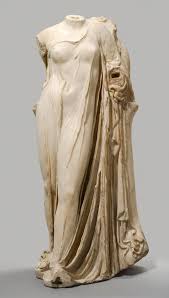
Among the most technically astonishing objects in the classical galleries is the marble torso known as the Isis sculpture. Here, the interpretive challenge is not iconographic but material: how did a sculptor manipulate cold, opaque stone to produce the illusion of translucent, water-soaked fabric clinging to a living body?
The technique is known as wet drapery—a method perfected by classical Greek sculptors, likely originating in the workshops of the late fifth century BC. The procedure involved carving marble in extremely thin, closely spaced folds that follow the contours of the anatomy beneath, creating the optical effect of fabric rendered nearly transparent by moisture. The stone appears to possess fluidity, movement, and sensuality that contradict its actual material properties.
This is stone manipulation at its most sophisticated. The sculptor must account for light refraction across micro-surfaces, the structural integrity of extremely thin carved ridges, and the anatomical accuracy of the body visible “through” the fabric. High fashion’s celebrated “wet look”—associated with houses like Gucci and Prada—is a direct descendant of this ancient technique, though the original practitioners achieved their results not with liquid fabric but with chisel and abrasive, coaxing movement out of crystalline calcium carbonate. The Isis sculpture is a masterclass in overcoming material resistance through virtuoso technique.
The Jüngling vom Magdalensberg: Roman Bronze Casting on Austrian Soil
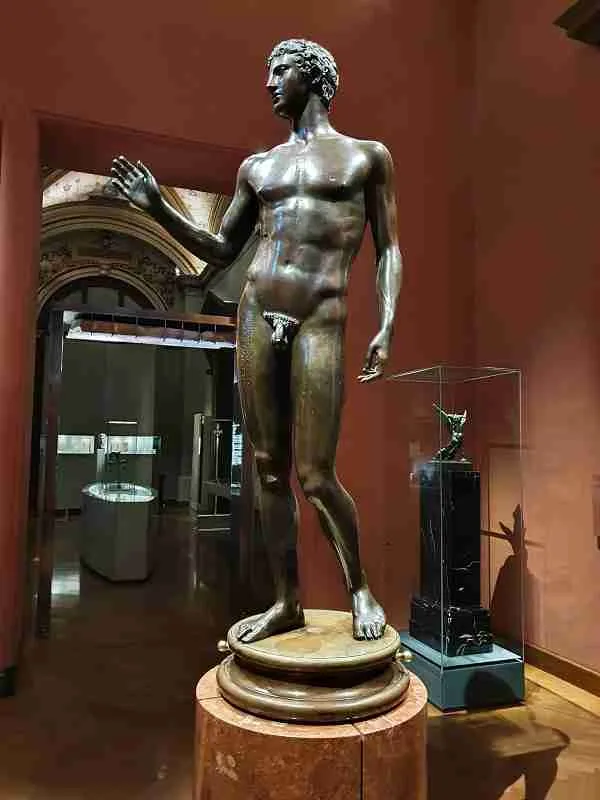
Before leaving the antiquities wing, seek out the Jüngling vom Magdalensberg—the Youth from Magdalensberg—a celebrated larger-than-life Roman bronze figure discovered in Carinthia, in Austria’s southern alpine region.
The sculpture itself is a commanding example of Roman bronze casting technique: a hollow-cast figure produced through the lost-wax method, in which a wax model is encased in a ceramic mold, the wax melted out, and molten bronze poured into the resulting cavity. The technical demands are formidable—controlling alloy temperature, ensuring even flow, preventing air pockets—and the scale of this figure makes the achievement all the more impressive.
Beyond its craftsmanship, the Magdalensberg Youth serves a critical contextual function within the KHM. It is material proof that high classical art was not confined to the Mediterranean basin. Roman cultural infrastructure—workshops, patrons, skilled bronze casters—extended deep into what is now Central European territory. The sculpture bridges Mediterranean antiquity and the alpine world, anchoring Vienna’s classical collections not as imported curiosities but as part of an unbroken local heritage connecting Austria to the Roman imperial network.
The Gemma Augustea: Material Science in Service of Political Propaganda
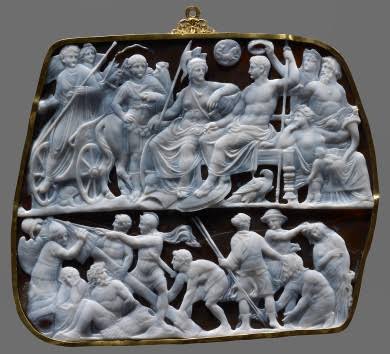
The culmination of any serious engagement with the Kunsthistorisches Museum’s antiquities is the Gemma Augustea—also known in older scholarship as the Gemma Tiberiana—one of the supreme surviving masterworks of ancient glyptic art.
The material alone demands attention. The cameo is carved from a single piece of two-layered Arabian onyx, a semi-precious stone composed of naturally occurring strata of contrasting color. The carver exploited this geological property with extraordinary precision, using the dark lower layer as a tonal backdrop and sculpting the white upper layer into high-relief figures that appear to float against their ground. The control required—working a brittle, layered mineral without fracturing across the strata boundary—represents material science of the highest order.
The iconographic program is equally calculated. The upper register depicts Emperor Augustus enthroned beside the goddess Roma, receiving a crown amid celestial and divine symbols. He is presented not as a mortal ruler but as a figure already operating within the sphere of the gods—a visual claim of divine legitimacy rendered in permanent stone. The lower register depicts Roman soldiers erecting a military trophy over defeated barbarian captives, grounding the divine upper scene in concrete martial dominance.
The Gemma Augustea is, in essence, the ultimate artifact of Roman political propaganda—an entire imperial ideology condensed into an object small enough to hold in the palm of a hand. It communicates divine right, military supremacy, dynastic continuity, and cosmic order through a medium chosen specifically for its durability and preciousness. Every element—material selection, chromatic contrast, compositional hierarchy, iconographic program—is engineered to serve a single strategic message: the inevitability and divinity of Augustan rule.
Why These Details Matter
The Kunsthistorisches Museum rewards preparation. Without context, its galleries present a beautiful but undifferentiated procession of ancient objects. With the right interpretive framework—one that foregrounds materiality, structural mechanics, and the political engineering behind curatorial choices—the museum reveals itself as something far richer: a three-dimensional argument about how civilizations build, borrow, propagate, and preserve power through art.
These are the kinds of insights and behind-the-scenes narratives that transform a standard museum visit into an intellectually immersive experience—the difference between passing through a gallery and genuinely reading it. For those who value precision, depth, and the kind of strategic cultural knowledge that only sustained local expertise can provide, a guided encounter with KHM Vienna is not a tour. It is a structured investigation into the material foundations of Western civilization, conducted in one of the most extraordinary repositories of evidence on earth.
References and Scientific Sources for the Kunsthistorisches Museum Collection
- Kunsthistorisches Museum: History and Architecture – Provides authoritative institutional context regarding the Habsburg dynasty’s commissioning of the Ringstrasse museum, validating how the structural engineering and architecture function as primary ideological artifacts.
- KHM Egyptian and Near Eastern Collection – Details the provenance of the museum’s Egyptian holdings, corresponding to the article’s analysis of the monolithic papyrus-bundle columns gifted during the 1869 Suez Canal opening.
- Heilbrunn Timeline of Art History: Cypriot Sculpture – A scholarly overview of ancient Cyprus as a cultural crossroads, supporting the article’s claim that Cypriot votive statues act as transitional objects bridging rigid Egyptian conventions and organic Greek naturalism.
- SmartHistory: The Invention of Contrapposto – Elaborates on the biomechanical paradigm shift of weight distribution in classical sculpture, corroborating the analysis of ‘Standbein und Spielbein’ as a fundamental engineering insight in art history.
- KHM Collection of Greek and Roman Antiquities – Offers official curatorial insights into the labyrinth mosaics and marbles housed in the classical wing, emphasizing the translation of mythology into mathematical precision.
- World History Encyclopedia: Greek Sculpture and Wet Drapery – Serves as a historical and material science reference explaining the complex late-fifth-century BC carving techniques used to simulate translucent, water-soaked fabric on solid marble forms like the KHM’s Iris.
- Austria-Forum: The Youth of Magdalensberg – An academic Austrian cultural encyclopedia entry confirming the Carinthian discovery of this commanding Roman bronze and its significance as proof of classical infrastructure extending into the alpine region.
- SmartHistory: The Lost-Wax Casting Process – A technical breakdown of the demanding metallurgical procedure utilized in creating large hollow-cast Roman bronzes, highlighting the challenges of alloy temperature and flow control.
- Livius History Archive: The Gemma Augustea – Provides a rigorous iconographic and historical decoding of the layered Arabian onyx cameo, confirming its function as a masterwork of Augustan political propaganda and divine legitimization.
- Google Arts and Culture: Kunsthistorisches Museum Vienna – Features high-fidelity digital archives and cross-referenced historical data mapping the civilizational evolution spanning from archaic relics to imperial Roman artifacts within the Habsburg collection.
We look forward to hearing from you:
Travel Guide
Climate Certified
Award Winner 2026
Transport Agent
State Certified
Water Sommelier
Come and experience travel!
Personally designed, seamlessly delivered – your journey, our expertise!
We are a boutique travel agency and consultancy specializing in Hub & Spoke Tours across Central Europe, the Benelux and the Dolomites.
Tour Guide