

Experience Travel Blog
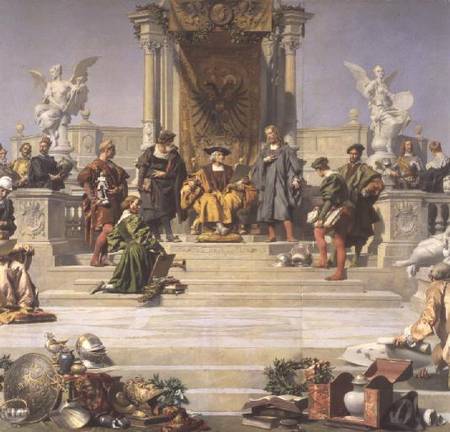
Beyond Gold & Marble: Unlocking the Kunstkammer at the KHM
What if a 1540s salt cellar encodes the same paradigm-shift dynamics you trace in your own data? This article dissects Habsburg-era objects at Vienna’s KHM the way you’d analyze anomaly accumulation before a scientific revolution—because that’s exactly what they document. You’ll see how Mannerist sculpture registers the collapse of Aristotelian certainty, why two imperial busts map an epistemological phase transition, and how one golden artifact models pre-Copernican cosmology.
by Long Lin-Maurer • October 3, 2026
Beyond Gold & Marble: Unlocking the Kunstkammer at the KHM
The Object Everyone Sees—and the Story Almost Everyone Misses
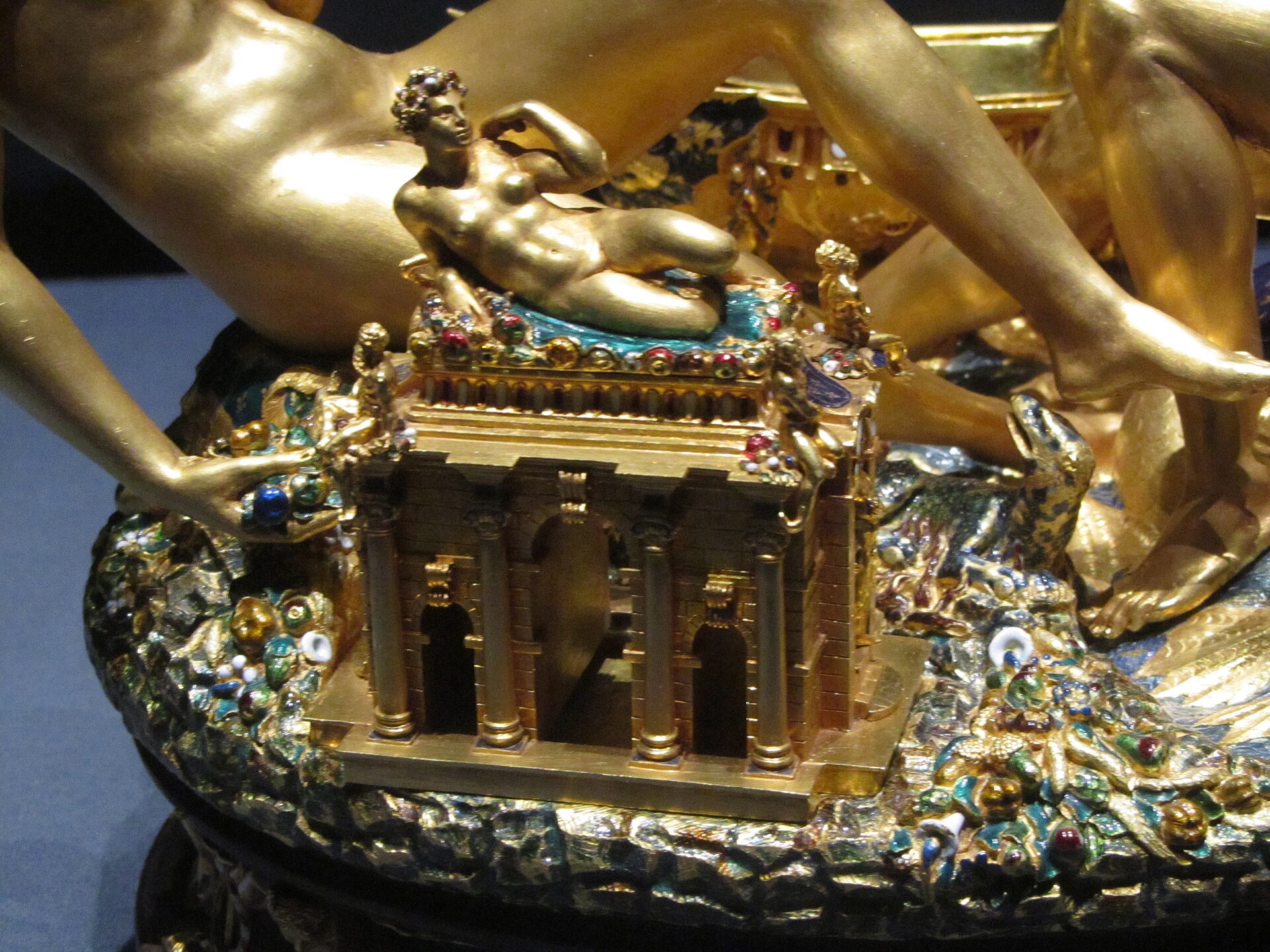
Every year, hundreds of thousands of visitors file through the grand halls of the Kunsthistorisches Museum in Vienna, and a significant number make a beeline for a single object: the Saliera by Benvenuto Cellini. It is, by any measure, extraordinary—a gold and enamel salt cellar commissioned by King Francis I of France in the 1540s, and arguably the most famous piece of goldsmith work in existence. Photographs reproduce well. The gleaming surface satisfies quickly. Most visitors pause, admire, photograph, and move on.
But to stop at the surface is to miss the entire point of the object—and of the vast collection that surrounds it.
Cellini did not craft a piece of luxury tableware. He engineered a microcosm. The Saliera is a cosmos in miniature: two reclining figures, one male and one female, personify Sea and Earth. Their intertwined legs symbolize the elemental convergence where salt emerges from ocean water and pepper grows from land. A small ship holds the salt; a miniature triumphal arch contains the pepper. The base rotates on an ebony platform calibrated to the arc of the day. It is, in the most literal sense, an Aristotelian model of the natural world compressed into a dining accessory—a thesis in gold about humanity’s capacity to understand, order, and aestheticize nature.
Come and experience travel!
Personally designed, seamlessly delivered – your journey, our expertise!
We are a boutique travel agency and consultancy specializing in Hub & Spoke Tours across Central Europe, the Benelux and the Dolomites.
This kind of layered reading is what transforms a visit to the Kunstkammer at the KHM from pleasant sightseeing into genuine intellectual engagement. And the Saliera is only the prologue.
The Kunstkammer: Not a Treasury, but a Theory of Knowledge
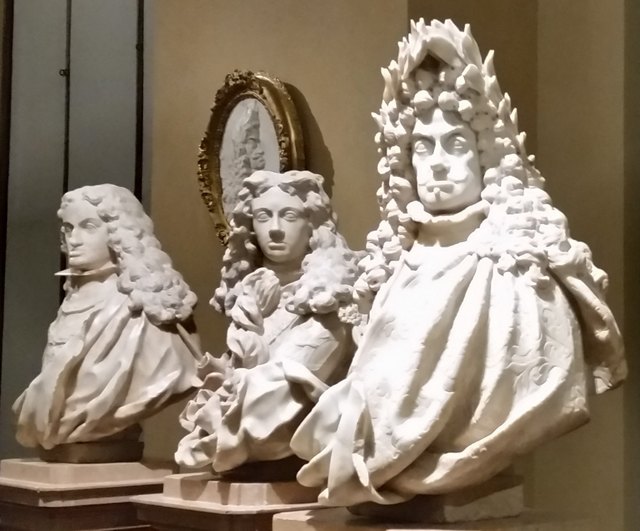
The term Kunstkammer—often translated as “Chamber of Wonders” or Wunderkammer—can be misleading to modern ears. It conjures images of curiosity cabinets stuffed with oddities. But the Habsburg imperial collections housed at the KHM were something far more systematic. The Kunstkammer was a proto-encyclopedic attempt to classify the known world through objects. Naturalia (specimens from nature), artificialia (human-made marvels), scientifica (instruments of measurement and observation), and exotica (objects from distant lands) were organized not randomly but according to a cosmological framework that placed the ruling dynasty at the intersection of divine order and earthly knowledge.
To walk through these rooms is to walk through a physical catalog of how European elites understood—and attempted to control—reality across several centuries. Each object is a data point in a shifting paradigm. And nowhere is that paradigm shift more legible than in two portrait busts that occupy the same gallery space yet belong to entirely different intellectual universes.
Charles V and the Architecture of Renaissance Certainty
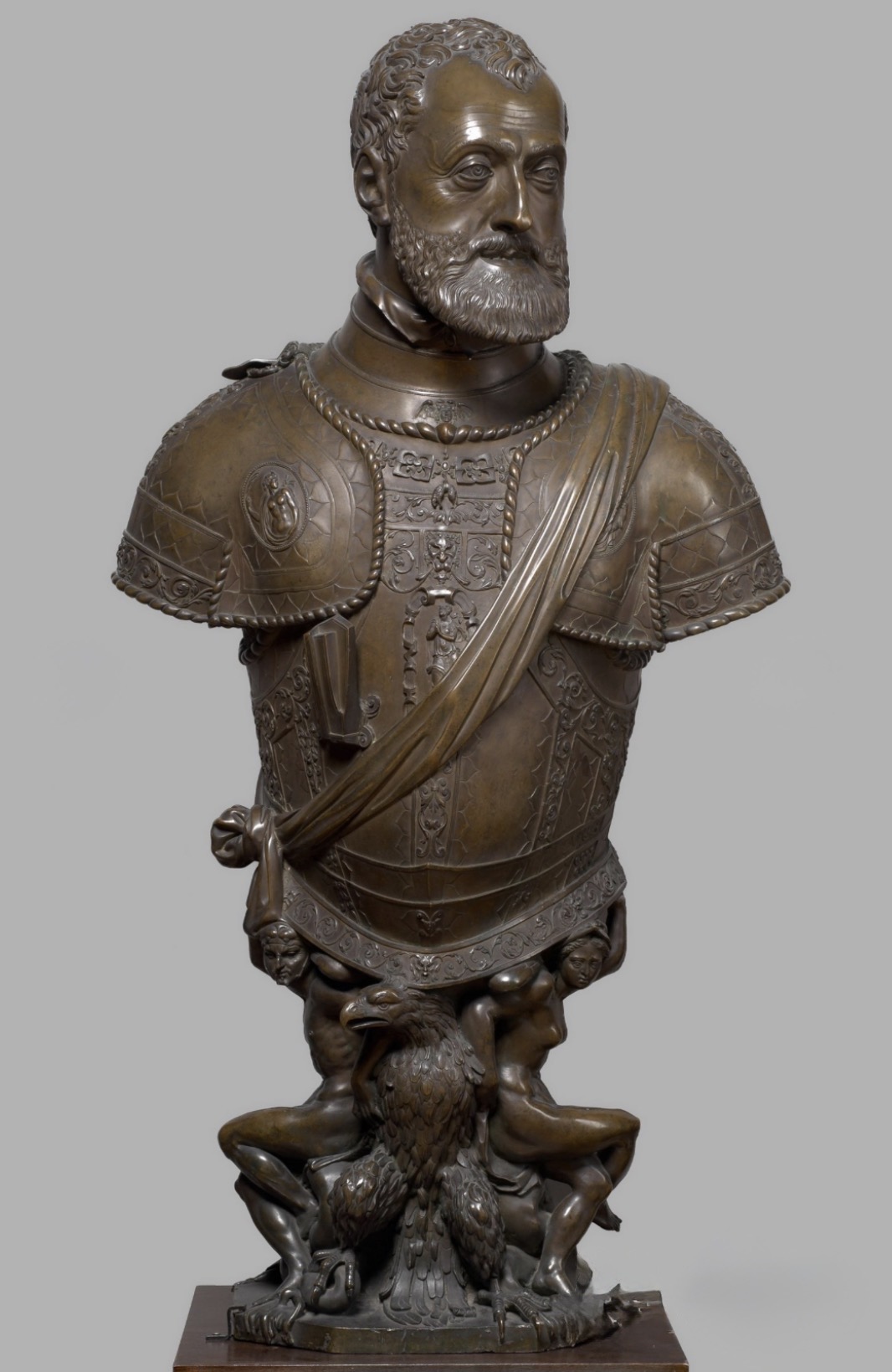
Emperor Charles V ruled the largest European empire since Charlemagne. His dominions stretched from Spain to the Netherlands, from Naples to the Americas—an empire, as the famous phrase goes, on which the sun never set. His portrait bust in the Kunstkammer is a distillation of the High Renaissance worldview that shaped his era.
Symmetry as Ideology
Examine the sculpture closely. The posture is grounded and vertical. The shoulders are level. The facial expression communicates composed authority—resolute but not agitated, firm but not theatrical. The proportions adhere to classical ideals inherited from Greco-Roman antiquity and codified by Renaissance theorists like Leon Battista Alberti: the human figure as a harmonious system of ratios reflecting the mathematical order of the cosmos.
This is not accidental. The High Renaissance worldview operated on the foundational premise that the universe was rational, proportionate, and knowable. God had designed creation according to geometric principles; human reason, properly applied, could decode those principles. Architecture, painting, sculpture, and governance all derived legitimacy from the same source: order. Karl V’s bust does not merely depict an emperor. It encodes an entire epistemology—one in which stability, clarity, and divine proportion are the highest aesthetic and political values.
The Political Context of Composure
It is worth noting that Karl V’s reign was, in reality, anything but serene. He fought wars on multiple fronts, confronted the Protestant Reformation head-on, and eventually abdicated in exhaustion. Yet the sculptural language chosen for his likeness deliberately suppresses that turbulence. The Renaissance portrait tradition functioned as a form of ideological architecture: the ruler must appear ordered because order itself was the foundational claim of legitimate authority. The bust is not a portrait of a man; it is a portrait of a worldview.
Rudolf II and the Fracturing of Certainty
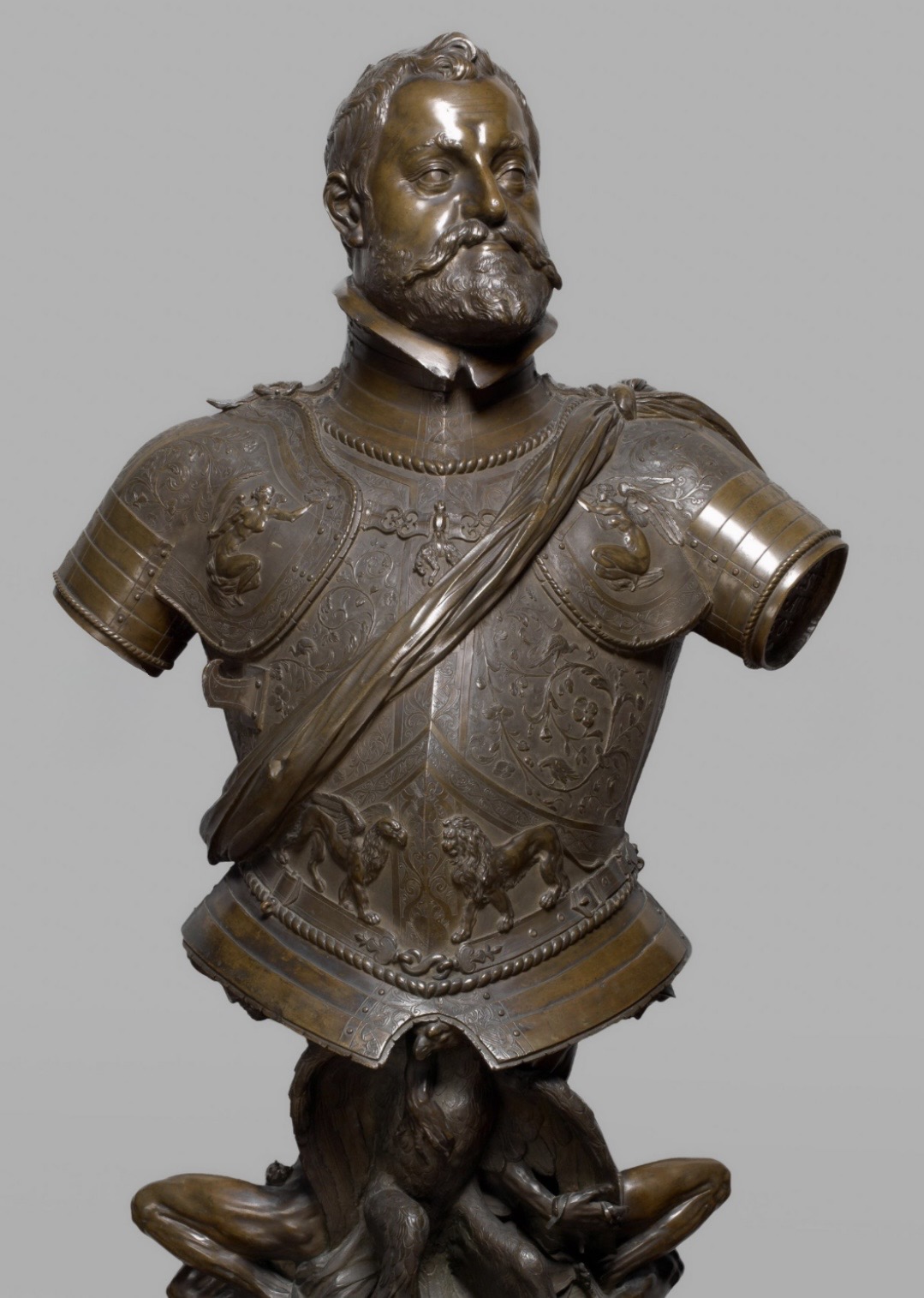
Now turn to the bust of Emperor Charles V’s grandson, Emperor Rudolf II, displayed in proximity within the same collection. The shift is immediate, visceral, and analytically fascinating.
Kinetic Tension in Bronze and Marble
Where Karl V’s bust is still, Rudolf II’s is restless. The head turns sharply. The armor is not smooth and idealized but elaborately worked with swirling, densely packed decorative motifs—surfaces that refuse to let the eye settle. The expression is intense, searching, perhaps anxious. There is a theatricality to the composition that would have been unthinkable in High Renaissance portraiture: the figure seems caught mid-motion, as if interrupted in thought or decision.
These are the defining characteristics of Mannerism—the stylistic movement that emerged in the decades after the High Renaissance and that scholars have long debated as either a decadent decline or a sophisticated response to a world that no longer fit neatly into Renaissance categories.
The Variables Behind the Style
Rudolf II’s era was defined by compounding instabilities. The Protestant Reformation had shattered the religious unity of Europe. The Ottoman Empire pressed against Habsburg borders. The Scientific Revolution was undermining centuries of Aristotelian certainty—Copernicus had published De revolutionibus in 1543, and by Rudolf’s reign, figures like Tycho Brahe and Johannes Kepler (both of whom Rudolf personally patronized at his court in Prague) were dismantling the geocentric model of the cosmos. Political friction within the Holy Roman Empire made governance an exercise in perpetual negotiation rather than command.
Mannerism, as a visual language, registers these pressures with remarkable fidelity. Where the High Renaissance insisted on harmony, Mannerist art embraced deliberate instability—elongated proportions, spatial ambiguity, anatomical distortion, and emotional complexity. It was not chaos for its own sake. It was a sophisticated acknowledgment that the old paradigm no longer accounted for observable reality. In scientific terms, Mannerism is the aesthetic equivalent of anomaly accumulation before a paradigm shift—the visual record of a civilization processing the fact that its models are breaking down.
Rudolf II’s bust captures this transitional moment in sculptural form. The kinetic energy, the ornamental complexity, the psychological intensity—all point forward, away from Renaissance equilibrium, toward the full dramatic vocabulary of the Baroque that would dominate the seventeenth century.
Two Busts, Two Paradigms: Reading the Transition
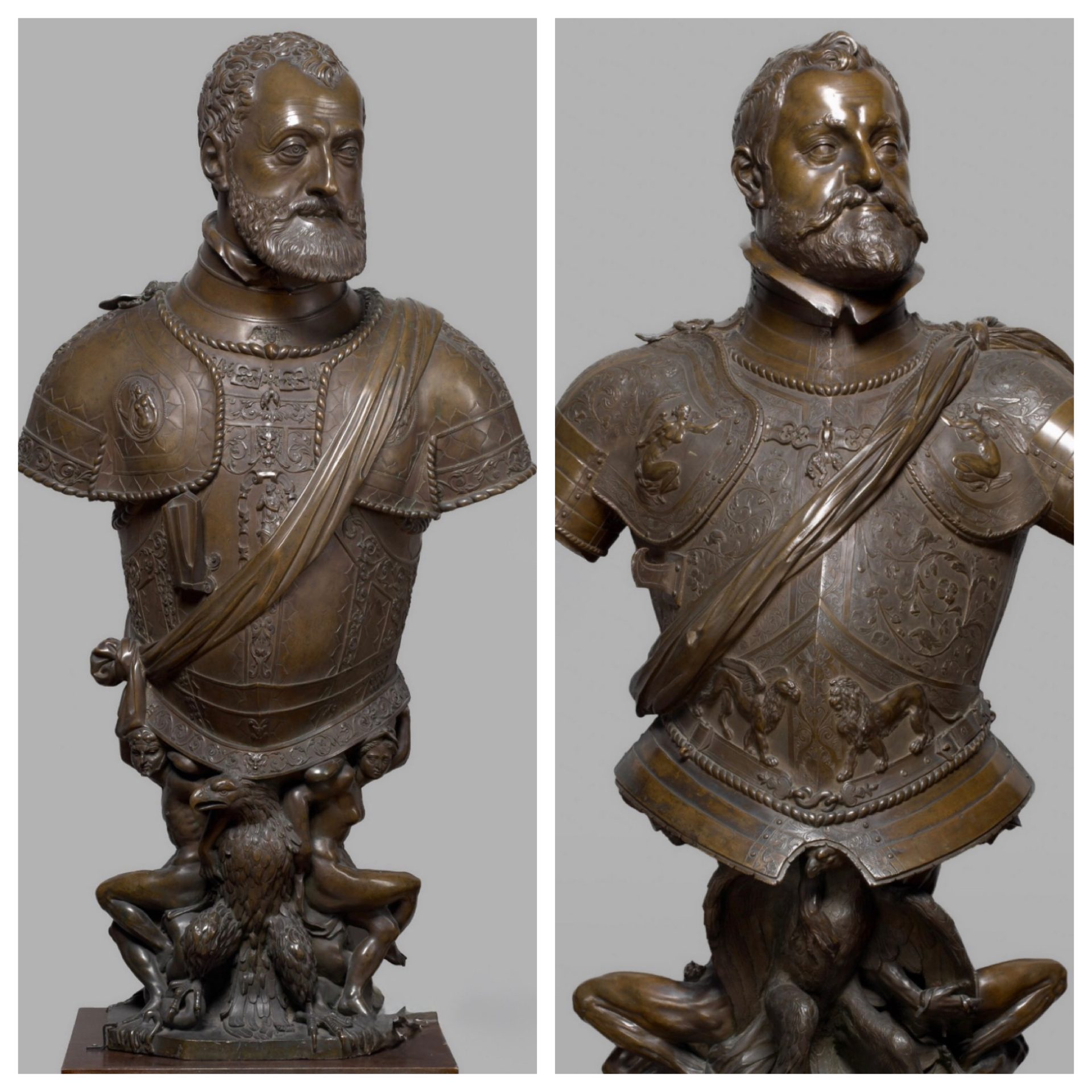
Placing these two imperial portraits in dialogue is one of the most instructive exercises available in any European museum. They are not simply different styles applied to different men. They are physical evidence of how fundamentally the European intellectual framework shifted in roughly a century.
Charles V’s bust says: The universe is ordered, and I embody that order.
Rudolf II’s bust says: The universe is in flux, and I am caught within it.
The sculptural differences—stillness versus motion, smooth surface versus dense ornament, frontal composure versus dramatic rotation—are not matters of taste. They are material consequences of historical variables: the Reformation, the Scientific Revolution, imperial overextension, and the erosion of a unified cosmological framework. To read these busts accurately is to read the intellectual history of early modern Europe through three-dimensional form.
Why Context Changes Everything
A museum label can provide a date, a material, and an attribution. What it cannot provide is the connective tissue—the causal logic that links a sculptor’s chisel stroke to an emperor’s political crisis, or an allegorical salt cellar to a pre-Copernican model of the natural world.
This is precisely where cultural mentorship transforms the experience. Viewing the Kunstkammer at the KHM through a contextual lens means treating each object not as an isolated aesthetic experience but as a node in a network of historical, scientific, and philosophical relationships. The Saliera becomes a thesis on natural philosophy. Karl V’s bust becomes a case study in ideological representation. Rudolf II’s portrait becomes a seismograph of societal friction.
For visitors trained in analytical reasoning—those accustomed to reading data, identifying variables, and tracing cause-and-effect relationships—this approach to the Habsburg imperial collections is not merely more rewarding. It is the only approach that does the material justice.
The Kunstkammer as Living Laboratory
The Kunstkammer was never intended as a static display. It was conceived as an active space for intellectual inquiry—a place where objects provoked questions about the nature of the world. Centuries later, the best way to honor that original purpose is to enter the collection with the same investigative spirit: not to consume beauty passively, but to interrogate it.
When the story behind the stone becomes legible—when the tension in a bronze shoulder plate connects to the anxiety of a collapsing worldview, when the golden limbs of an allegorical figure reveal a Renaissance theory of elemental harmony—history ceases to be a static timeline. It becomes a dynamic, continuously interpretable system.
And that is the difference between seeing a museum and truly reading one.
Recommended Reading: Contextualizing the Kunstkammer
- Kunstkammer Wien (Kunsthistorisches Museum) – The official institutional guide to the Habsburg collections, detailing the systematic categorization of objects into naturalia, artificialia, scientifica, and exotica.
- The Saliera by Benvenuto Cellini (KHM Object Database) – The museum’s curatorial and scientific record of the famous salt cellar, explaining its metallurgical engineering and its function as a cosmological model.
- The Kunstkammer (Metropolitan Museum of Art) – An extensive art-historical essay tracing the evolution of curiosity cabinets and their role as a structural theory of knowledge for early modern European elites.
- Cellini’s Salt Cellar: Sea and Earth (Smarthistory) – An academic breakdown of Cellini’s masterwork that analyzes the philosophical layers and Aristotelian themes encoded within this renowned Kunstkammer object.
- Charles V, Holy Roman Emperor (Encyclopedia Britannica) – A detailed historical overview of Karl V’s reign, providing vital context for the political turbulence that his idealized Renaissance portraits actively sought to culturally suppress.
- Italian Renaissance Art (National Gallery of Art) – Explores the foundational premises of High Renaissance aesthetics, particularly how classical ideals of symmetry and proportion were utilized as visual proof of an ordered, knowable universe.
- Rudolf II, Holy Roman Emperor (Encyclopedia Britannica) – Historical background on Rudolf II’s complex rule, his relocation of the Habsburg court, and his profound patronage of the scientific and artistic vanguards.
- Mannerism: An Introduction (Smarthistory) – Provides essential context on the Mannerist movement, explaining its intentional departure from High Renaissance equilibrium as an aesthetic response to societal and scientific fracturing.
- The Scientific Revolution (Stanford Encyclopedia of Philosophy) – A rigorous academic analysis of the dismantling of Aristotelian frameworks, offering insight into the shifting paradigms that deeply influenced early modern epistemology and art.
- Johannes Kepler and the Court of Rudolf II (University of Oklahoma History of Science) – Documentation examining the work of Kepler and Tycho Brahe under Rudolf II’s direct patronage, illustrating the accumulation of scientific anomalies that broke down geocentric certainty.
We look forward to hearing from you:
Travel Guide
Climate Certified
Award Winner 2026
Transport Agent
State Certified
Water Sommelier
Come and experience travel!
Personally designed, seamlessly delivered – your journey, our expertise!
We are a boutique travel agency and consultancy specializing in Hub & Spoke Tours across Central Europe, the Benelux and the Dolomites.
Tour Guide