

Experience Travel Inspiration
Poulard en Vessie: The Legendary Haute Cuisine Secret Cooked in a Pig’s Bladder
What if the most revolutionary dish you’ll ever taste requires no modern technology—just a pig’s bladder and 200 years of French wisdom?
Poulard en Vessie isn’t just dinner; it’s edible history that most American food lovers have never encountered. Discover why Michelin’s first six-star chef perfected this technique, the surprising science behind its unmatched flavor, and where to find an Austrian master keeping this aristocratic tradition alive—just an hour from Vienna.
by Long Lin-Maurer • June 2, 2026
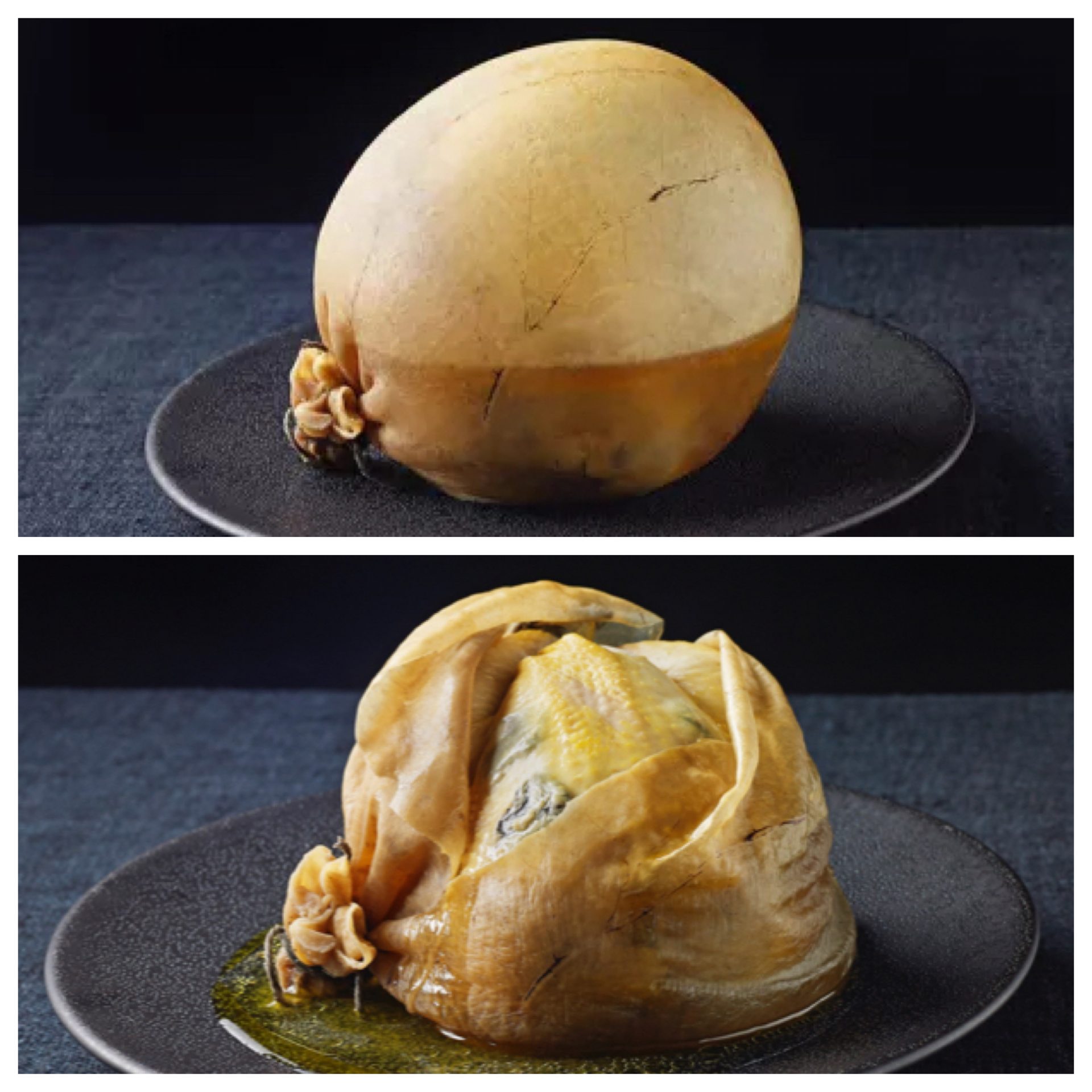
A Culinary Time Capsule from the Courts of France
In an age where molecular gastronomy and avant-garde techniques dominate fine dining headlines, one of the most extraordinary dishes in European cuisine requires nothing more than a pig’s bladder, an exceptional chicken, and centuries of accumulated wisdom. Poulard en Vessie—chicken cooked inside an inflated pig’s bladder—stands as a monument to the ingenuity of classical French haute cuisine, a technique so revered that it once graced the tables of emperors and has now found an unlikely champion in the rolling vineyards of Austria’s Burgenland region.
This dish represents far more than a peculiar cooking method; this chicken in a bladder embodies a philosophy of respect for ingredients, patience in preparation, and the pursuit of flavors so pure and concentrated that modern cooking methods simply cannot replicate them. For the American gourmand seeking authentic culinary experiences beyond the well-trodden paths of Paris and Lyon, understanding Poulard en Vessie opens a door to a hidden world of European gastronomy that few travelers ever encounter.
Come and experience travel!
Personally designed, seamlessly delivered – your journey, our expertise!
We are a boutique travel agency and consultancy specializing in Hub & Spoke Tours across Central Europe, the Benelux and the Dolomites.
The Birth of Lyonnaise Bladder Chicken in Lyon’s Golden Age
The origins of Poulard en Vessie trace back to Lyon, France, long celebrated as the capital of French gastronomy. While the precise inventor remains lost to history, the dish achieved its legendary status through the hands of the “Mères Lyonnaises”—the remarkable female chefs who dominated Lyon’s restaurant scene from the late 19th century through the mid-20th century.
Among these culinary matriarchs, Mère Fillioux stands as the most significant figure in the dish’s history. Françoise Fillioux, who ran her restaurant from 1890 until her death in 1925, perfected the art of Poularde demi-deuil, a closely related preparation where slices of black truffle are slipped beneath the skin of a Bresse chicken before it undergoes the bladder-cooking process. Her technique was so precise that she reportedly carved over half a million chickens in her lifetime, each one with identical perfection.
The tradition passed from Mère Fillioux to her protégée, Eugénie Brazier, who became the first chef in history to earn six Michelin stars—three for each of her two restaurants. Brazier’s version of the Lyonnaise bladder chicken cemented its place in the French culinary canon, and her influence extended to a young apprentice named Paul Bocuse, who would later become the pope of nouvelle cuisine.
Bocuse carried the torch forward, making Poulard en Vessie one of the signature dishes at his legendary restaurant in Collonges-au-Mont-d’Or. Under his guidance, what many came to know as Bocuse’s bladder chicken transcended regional specialty to become an international symbol of classical French haute cuisine, served to presidents, royalty, and discerning gourmands from around the world.
The Science of Bladder-Cooked Chicken
So, what makes this method of creating a vessie-poached chicken so remarkable? The answer lies in the elegant simplicity of the physics involved and the transformative effects on flavor and texture.
When a chicken is sealed inside a cleaned and inflated pig’s bladder with aromatics, truffles, and stock, then gently poached, something magical occurs. The bladder acts as a completely natural, hermetically sealed cooking vessel. Unlike any modern alternative, including sous vide bags or vacuum sealing, the bladder membrane allows for a unique exchange—it is semi-permeable, breathing ever so slightly while retaining all the precious juices and aromatics within.
As heat penetrates the bladder, the chicken essentially braises in its own concentrated essence. No flavor escapes into the cooking liquid. The breast meat, notoriously prone to drying out, remains impossibly succulent because it never comes into direct contact with the poaching liquid. Meanwhile, the dark meat achieves the tender, falling-apart quality that typically requires much higher temperatures during conventional poaching.
The black truffle, if included, infuses its earthy perfume throughout the flesh in a way that simply cannot be achieved through other methods. The aromatic vegetables and herbs contribute their essences in concentrated form. When the bladder is finally punctured at the table—a dramatic moment of tableside service that releases an intoxicating cloud of steam and perfume—diners experience a truly multisensory moment that connects them directly to centuries of culinary tradition.
This resourceful preparation of hen in a bladder, born of necessity in peasant kitchens, achieved its highest expression in the grand restaurants of Lyon. It represents a philosophy of nose-to-tail cooking that resonates deeply with contemporary values, transforming waste into an essential cooking implement.
Max Stiegl and the Austrian Renaissance of a French Classic
In the picturesque village of Purbach am Neusiedlersee, nestled between the Leithagebirge mountains and the vast steppe lake of Neusiedlersee in Austria’s Burgenland region, an unexpected guardian of this French tradition has emerged. Max Stiegl, the chef-proprietor of Gut Purbach, has not merely adopted Poulard en Vessie—he has made it a centerpiece of his culinary philosophy and a symbol of his commitment to preserving this significant piece of culinary heritage.
Stiegl represents a particular breed of chef increasingly rare in the modern culinary landscape: one who sees himself as a custodian of endangered traditions like the art of preparing chicken cooked in a pig’s bladder, rather than a seeker of novelty. His restaurant, set within a historic estate surrounded by vineyards, has become a pilgrimage site for those who understand that true culinary innovation often means looking backward rather than forward.
What makes Stiegl’s interpretation particularly compelling is its Austrian context. Burgenland’s culinary heritage draws from Hungarian, Croatian, and Austrian influences, creating a unique gastronomic terroir. Stiegl sources his chickens from local farmers who raise heritage breeds with the same care that Bresse farmers bring to their celebrated poultry, the foundation for the original Poularde de Bresse en Vessie.
Stiegl’s commitment to this dish extends beyond mere reproduction. He has studied the technique obsessively, traveling to Lyon, consulting historical sources on Poulard en Vessie, and experimenting with variations that honor the original while expressing his own culinary voice. His kitchen maintains relationships with butchers who can supply the pig bladders essential to the preparation—connections that require trust built over years.
A Journey for the Curious Palate
For American travelers seeking culinary experiences that transcend the ordinary, Poulard en Vessie represents the pinnacle of what European gastronomy can offer: a dish with deep historical roots, technical brilliance, philosophical depth, and the kind of theatrical presentation that creates lasting memories. Finding it in Austria rather than France adds an element of discovery that transforms a meal into an adventure.
The journey to Purbach from Vienna takes less than an hour, passing through some of Austria’s most beautiful wine country. The village itself offers the charm of a Central European settlement untouched by mass tourism, where local wine taverns serve regional specialties and the pace of life encourages lingering over meals.
This is precisely the kind of hidden culinary treasure that rewards travelers willing to venture beyond guidebook recommendations—a taste of history, a classic bladder-cooked chicken prepared by passionate hands, in a setting that enhances rather than overshadows the experience on the plate.
POULARD EN VESSIE – Historical and Cultural Resources
- Larousse French Dictionary – Definition of “Vessie”
- Bibliothèque nationale de France – Historical French Cooking Texts
- Encyclopedia Britannica – Food Preservation Methods
- JSTOR – French Culinary History Studies
- Wikiwand – Poularde (French)
- Europeana – Food and Drink Heritage Collections
- Internet Archive – Classical French Cooking Literature
- Oxford Reference – The Oxford Companion to Food
- UNESCO – French Gastronomic Meal Intangible Heritage
- Biodiversity Heritage Library – Historical Culinary and Agricultural Texts