

Experience Travel Inspiration
From Vienna 1900 to Tiffany: How Vienna Secessionism Went Global
What if one of America’s most beloved artists—Louis Comfort Tiffany—shared a secret creative dialogue with Vienna’s revolutionary painters?
This article reveals surprising connections between the Vienna Secession and American decorative arts that most tourists never discover. You’ll learn how world expositions linked these movements, why Japanese art inspired both, and which Vienna sites let you trace this transatlantic story yourself.
by Long Lin-Maurer • July 1, 2026
The International Echo of Vienna 1900: How a Revolutionary Art Movement Crossed the Atlantic
The Dawn of Viennese Modernism and the Secession
At the close of the nineteenth century, Vienna stood at a remarkable crossroads. The Habsburg capital, seat of an empire spanning twelve nations and fifty million souls, was experiencing an unprecedented explosion of creative energy. While Emperor Franz Joseph maintained the rigid protocols of court life in the Hofburg Palace, just beyond those ancient walls, a generation of artists, architects, and designers—the pioneers of Viennese Modernism—were staging nothing less than a revolution in visual culture.
The year 1897 marked a decisive rupture. A group of young artists, led by the painter Gustav Klimt, formally broke away from the conservative Künstlerhaus, the official exhibition society that had dominated Viennese art life for decades. They called themselves the Secession—a deliberate declaration of independence from academic tradition. Their motto, inscribed in golden letters above the entrance to their newly constructed exhibition hall, proclaimed: “To every age its art, to art its freedom.”
Come and experience travel!
Personally designed, seamlessly delivered – your journey, our expertise!
We are a boutique travel agency and consultancy specializing in Hub & Spoke Tours across Central Europe, the Benelux and the Dolomites.
This was not merely a local quarrel among painters. The Vienna Secession would become one of the most influential art movements in modern history, sending shockwaves across Europe and, crucially, across the Atlantic Ocean. The international echo of Vienna 1900 was beginning to resonate. The dialogue between this Viennese innovation and American creative ambition produced some of the most extraordinary achievements of turn-of-the-century art—a story of transatlantic influence that remains surprisingly little known among travelers today.
The Secession Building and the Ideal of Gesamtkunstwerk
To understand the global reach of the Vienna Secession, one must first understand its physical and philosophical heart: the Secession Building itself. Completed in 1898 to designs by Joseph Maria Olbrich, this temple to modern art was unlike anything Vienna—or indeed Europe—had ever seen.
The building announced its revolutionary intent through every architectural choice. Gone were the historical decorations that covered nearly every public building in the Ringstrasse era. In their place, Olbrich created clean geometric forms, characteristic of the emerging Jugendstil style, crowned by an extraordinary dome of gilded laurel leaves—the famous “golden cabbage” that Viennese wags immediately christened it. The white walls gleamed with almost aggressive simplicity, while the interior spaces were designed as flexible, light-filled galleries.
The philosophical program was equally radical. The Secessionists rejected the hierarchy that separated “fine art” from “decorative art.” They believed that painting, sculpture, architecture, furniture design, metalwork, and graphic arts should be unified in a total work of art—the Gesamtkunstwerk that Richard Wagner had theorized for opera. This vision of artistic unity would prove enormously influential, establishing a worldwide legacy for Viennese art. And nowhere did it find more fertile ground than in the workshops and galleries of American designers who were pursuing remarkably similar ideals.
Louis Comfort Tiffany: An American Counterpart to Viennese Innovation
Three thousand miles from Vienna, in the bustling commercial metropolis of New York, another artistic revolution was underway. Louis Comfort Tiffany, son of the famous jeweler Charles Lewis Tiffany, had transformed himself from a promising painter into one of the most innovative decorative artists in America.
Tiffany’s journey paralleled the Secessionists’ in striking ways. Like Gustav Klimt and his colleagues, Tiffany rejected the rigid boundaries between art forms. His studios produced stained glass windows, lamps, mosaics, jewelry, pottery, and interior designs, all unified by a distinctive aesthetic vision. Like the Viennese, he drew inspiration from nature—not the idealized nature of academic painting, but the actual forms of flowers, insects, peacock feathers, and flowing water.
The connections between Tiffany and Vienna were not merely coincidental. Vienna 1900’s international artistic dialogue was facilitated through a web of personal contacts, exhibition exchanges, and shared sources of inspiration that linked the artistic avant-gardes of Europe and America in the years around 1900.
Pathways of Transatlantic Influence: The World Expositions
The great international expositions of the late nineteenth and early twentieth centuries served as crucial meeting points for artists and designers from different nations. These massive gatherings—the World’s Columbian Exposition in Chicago in 1893, the Paris Exposition Universelle of 1900, the Louisiana Purchase Exposition in St. Louis in 1904—were key venues for this transatlantic influence, functioning as showcases where the latest innovations could be seen and absorbed.
Vienna played a decisive role in these international exchanges. Austrian exhibitions at these world’s fairs presented not just individual artworks but complete room installations that demonstrated the Secessionist ideal of unified design. Visitors encountered spaces where every element—walls, floors, furniture, lighting fixtures, door handles—had been conceived as part of a harmonious whole.
Tiffany, who exhibited prominently at these same expositions, could hardly have missed the Austrian displays. His own chapel interior at the 1893 Chicago fair pursued strikingly similar goals. The dialogue between American and Viennese approaches to decorative art intensified through these encounters.
More direct connections came through the international art press. Siegfried Bing, the Parisian dealer whose gallery gave Art Nouveau its name, promoted both Tiffany’s work and Viennese design. The magazine “The Studio,” published in London but read avidly on both sides of the Atlantic, regularly featured articles on the Vienna Secession alongside coverage of American decorative arts, demonstrating the global spread of the Vienna Secession.
Shared Sources: Japan and the Language of Nature
One crucial source of inspiration linked Tiffany and the Viennese Secessionists directly: the art of Japan. The far-reaching effect of Vienna 1900 art and its American counterparts was deeply shaped by this shared passion after the opening of Japan to Western trade in the 1850s unleashed a wave of enthusiasm for its visual culture.
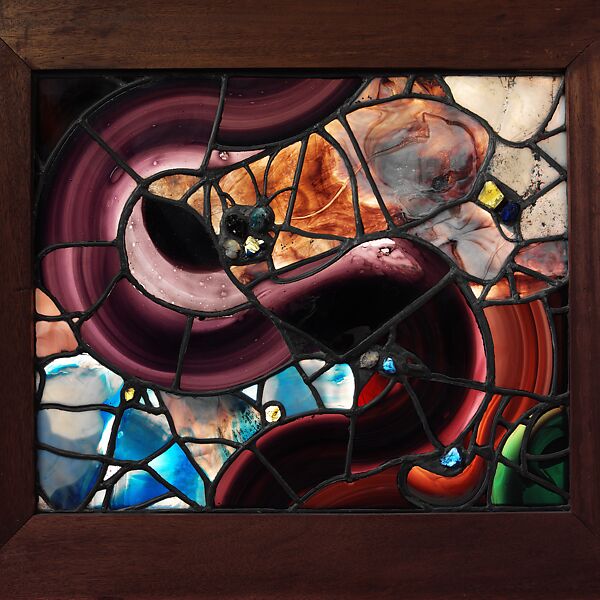
Both Tiffany and the Viennese artists absorbed Japanese lessons deeply. The asymmetrical compositions, the bold outlines, the flattening of pictorial space, and the attention to the decorative potential of natural forms—all these characteristics of Japanese art reappeared, transformed, in Secessionist paintings and Tiffany glass alike. Gustav Klimt’s paintings show the influence most dramatically, while Tiffany’s windows achieved similar effects by translating natural forms into richly colored glass that emphasized surface pattern over illusionistic depth.
The Aesthetics of Light: A Shared Viennese and American Obsession
Perhaps the deepest connection between Tiffany and the Vienna Secession lies in their shared obsession with light and color. Klimt’s use of gold leaf created surfaces that seemed to glow from within. Koloman Moser’s stained glass designs for the Kirche am Steinhof, a church on the outskirts of Vienna completed in 1907, used colored light to create an atmosphere of transcendent beauty.
Tiffany, of course, made colored light his central medium. His development of opalescent glass—glass that was itself colored rather than painted—represented a technical and aesthetic breakthrough. His famous lamps transformed electric light, that harsh new technology, into something warm, organic, and beautiful. This dedication to craft and beauty was a hallmark of the Art Nouveau movement.
The two traditions were not identical, but they were speaking the same language. Both sought to create environments of heightened aesthetic experience, spaces where modern people could find respite from industrial ugliness. Both believed that surrounding oneself with beautiful objects was not mere luxury but a form of spiritual cultivation, a core tenet of Viennese Modernism.
The Worldwide Legacy of Vienna 1900: A Living Heritage
Today, the legacy of the Vienna Secession remains remarkably accessible to visitors. The Secession Building still stands on the Karlsplatz, hosting contemporary art exhibitions. Klimt’s Beethoven Frieze, created for a 1902 exhibition, remains in the basement gallery, a masterpiece of visionary intensity.
The applied arts collections of the MAK (Museum of Applied Arts) preserve furniture, metalwork, glass, and textiles by Secessionist designers. The Leopold Museum houses the world’s greatest collection of works by Klimt and his younger colleague Egon Schiele. The Belvedere Palace displays Klimt’s “The Kiss,” perhaps the most famous painting of the entire era.
Beyond these major institutions, Vienna offers countless opportunities to encounter the Secessionist heritage in situ. The Kirche am Steinhof, Otto Wagner’s masterpiece of sacred architecture, still conducts services beneath Koloman Moser’s glowing windows. Wagner’s Postsparkasse (Postal Savings Bank), with its functional elegance, remains a working building. Private apartments designed by Josef Hoffmann still serve as homes.
Understanding the connections between this Viennese world and American artistic traditions adds another dimension to the experience. Walking through the Secession Building, one can imagine Louis Comfort Tiffany examining these same spaces. The dialogue between cultures that shaped modern art remains alive, waiting to be discovered by travelers willing to look beyond the surface of tourist Vienna into its revolutionary heart. This enduring connection is the true international echo of Vienna 1900.
The International Echo of Vienna 1900
- Britannica: Vienna Secession – Comprehensive overview of the Vienna Secession movement and its international influence on modern art and architecture.
- Metropolitan Museum of Art: Vienna around 1900 – Detailed analysis of Viennese art, design, and cultural innovations that resonated globally.
- Oxford Art Online: Vienna 1900 – Scholarly article examining the artistic and cultural movements that defined fin-de-siècle Vienna.
- JSTOR: The Vienna Secession and International Modernism – Academic article discussing the global reception and impact of Viennese modernism.
- Victoria and Albert Museum: Modernism 1900-1945 – Contextualizes Vienna 1900’s contribution to international modernist movements.
- Europeana: Art Nouveau – A Universal Style – Explores Vienna’s role in the pan-European Art Nouveau movement and its worldwide influence.
- Getty Research Institute: Vienna 1900 – Resources on the intellectual and artistic exchange between Vienna and other international centers.
- Tate: Gustav Klimt and Modern Life in Vienna 1900 – Exhibition documentation highlighting international reception of Viennese visual culture.
- Internet Archive: Vienna 1900 – Art, Architecture & Design – Digitized scholarly work on the international dissemination of Viennese aesthetic innovations.
- WorldCat: Vienna 1900 – From Altenberg to Wittgenstein – Bibliography of scholarly resources on the intellectual and cultural impact of fin-de-siècle Vienna worldwide.
We look forward to hearing from you:
Travel Guide
Climate Certified
Award Winner 2026
Transport Agent
State Certified
Water Sommelier
Come and experience travel!
Personally designed, seamlessly delivered – your journey, our expertise!
We are a boutique travel agency and consultancy specializing in Hub & Spoke Tours across Central Europe, the Benelux and the Dolomites.
Tour Guide